
 My Melodrama

 Catch while you still can
THEODORA SKIPITARES: THE PUPPET MASTER
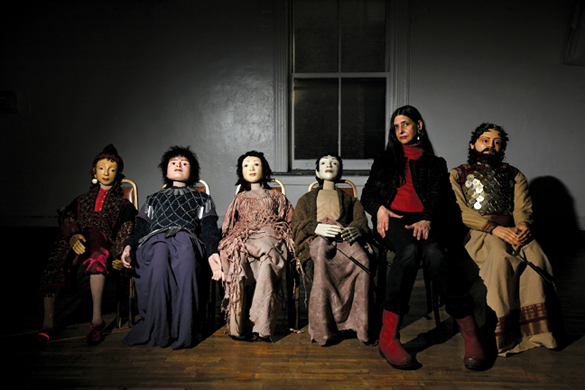
Theodora Skipitares has spent forty years building a puppet population in New York City. Her work emerged from the 1970s feminist second wave, a time when the body was the primary storytelling medium—at one point, she performed in an eighty-pound dress made entirely of walnuts. But as she began introducing “little Theodoras” to the stage, the puppets eventually overtook her. There were so many of them that she left the stage herself, moving behind the scenes to create and direct the miniatures that had replaced her.
Today, her studio is an archive where Charles Darwin, ancient Greek runners, and the delivery workers of the Lower East Side coexist in plywood and paint. It is a vast assembly of figures that spans centuries, currently stationed in a barn in Upstate New York waiting for their next cycle. Melodrama caught up with the legendary maker to discuss the evolution of her craft, the act of walking, and 1980s Amsterdam.
Louise Snouck Hurgronje: Hi Theodora! Thank you so much for taking the time. I’ve been a fan from a distance, so I was excited to see your piece at LaMaMa last weekend. Has it been 30 years that you’ve been making your puppets?
Theodora Skipitares: Well, it’s been actually 40 years.
LSH: Wow.
TS: Yeah. How about you? Is your background theater art or?
LSH: Yes. Well I started as an actress myself and have been producing my own shows in Amsterdam, which is where I’m based most of the time. And now I’m editing Melodrama.
TS: Oh, you’re kidding! Oh my god, I just love Amsterdam and I loved the creative scene that happened, you know, in the 70s, 80s, and 90s there.
LSH: Really! Tell me more!
TS: The thing is that for those of us that were doing performance art in the 80s, we would have starved to death had it not been for Amsterdam and of course for the Mickery Theatre. Do you remember them?
LSH: Gosh I’m going to sound like a philistine now… I don’t.
TS: Oh, look them up. They were an incredible theater, the Mickery, and they brought international groups in sometimes very flamboyant ways, like they would bring a 40-person Japanese experimental theater group to Amsterdam.
LSH: I’m going to look them up immediately. I fear they’re no longer around.
TS: No, they haven’t been around for I would say a good 10 years maybe, but they spawned a great theater school called DasArts which I think now has changed a lot too. I think it was formed like 20 years ago, but I think it’s shifted. Really international, stretching the outer limits of performance. Kind of really, amazing.
LSH: Were you going to Amsterdam at that time?
TS: Well, I went back a few times and, um, actually the Ape-man that starts the show that you saw was brought over there and they performed it.
LSH: Oh gosh, how long have you been showing that piece?
TS: Oh that’s the one piece that was not made in this cycle, and that was I think from 1990. But the theme was so perfect, you know? On four feet, then three, then two.
LSH: How did the walking theme for this show materialize?
TS: You know, I cannot tell you. One idea just kind of comes to me and I spend a lot of time – well, several months researching it and then I start making all sorts of things, and I cannot tell you why walking enthralled me. I don’t know. I mean, there’s that great book by Rebecca Solnit called Wanderlust, which is an amazing, amazing book where she gathers all these strands of walking. That was a big inspiration. But I don’t even remember why I got interested in walking.
LSH: Perhaps because it’s an unavoidable fact of life for many of us.
TS: Yeah.
LSH: I think my favorite moment in this show was towards the end, the delivery workers song…
TS: You know what was fun about that, I was reading a lot of interviews with delivery workers and I handed these interviews to Skip who has written not only the music, but the lyrics for the show – he’s a really great composer/lyricist, we have collaborated on seven shows and our first piece was in 2009. And in a day it came really fast to him. He took the best parts of these oral histories of these delivery workers and turned it into a great song. And that refrain line, you know, “I end up in the hospital and the employer calls to see if the food order is okay,” that was straight out of these interviews with the delivery workers, you know?
LSH: What drew you to the story of delivery workers? Are you ordering a lot of food yourself?
TS: No, I never do, ever. It’s just something I never ever do. I think I was reading about these ancient Greek runners and also Japanese ones that would run phenomenal distances and then drop dead when they delivered their message. And I thought, that’s sort of like the reckless traffic of people that are running around on bikes all day long delivering food and not getting tipped and stuff like that.
LSH: So on to your majestic puppets, do you make them all yourself?
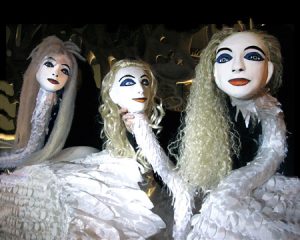
TS: I make most of them, but there’s a person right now that’s working in the studio with me, Jan Leslie Harding, who’s actually an award-winning actress, but she also makes great things. So it’s been her and me pretty much in the studio for eight or nine months.
LSH: So do you now have a little puppet army? And where are they all stored?
TS: They live in a barn in Upstate New York, and there’s hundreds of them.
LSH: Oh my god, this must be an amazing thing to behold.
TS: Well, this August, there’s going to be an exhibition of a bunch of them at a Lower East Side gallery – at a huge community center, the Soto-Velez Cultural Center.
LSH: Are all puppets created equal in your eyes?
TS: Oh, I have favorites for sure. There’s a giant from The Harlot’s Progress.
LSH: Oh, but that’s my favorite one! I discovered an image of that years ago and I was just like that’s completely magical.
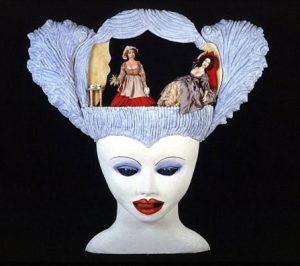
TS: That’s great! And then I love this one from Egypt. The Ape is pretty cool, and let’s see, what else are my favorites? I made one of Benjamin Banneker that’s beautiful and then Charles Darwin is really old, but he’s a good old soul.
LSH: You’ve brought so many different historical figures sort of back to life in puppet form.
TS: Well, it’s funny because one reviewer who actually has liked my work very much, he said this show was like an overly ambitious wild school project. But I do think that in a way, in the best sense of the word, I think that is what it is, you know, in a funny way. But in such a unique style. I mean, I know that my style is just very unique.
LSH: Which artists or puppeteers inspire you?
TS: A lot of visual artists inspired me. My performance art really came out of the 70s feminist second wave with artists like Carolee Schneemann who I knew. There were so many people that suddenly started using the woman’s body as the storytelling medium, you know? And that I did that for a while, although finally I wasn’t very comfortable being on stage myself, so I started bringing these little Theodoras on stage and they overtook me. There were so many on the stage that I left and I became the director and that was very comfortable for me.
LSH: Do you feel that audience reactions to your work have changed?
TS: Oh, definitely, because an American audience started out not being very sophisticated about what puppetry could do, extend its borders, you know? But now, thanks to the Jim Henson family who support a lot of puppetry. They’re the only American institution that does, the only one. Cheryl Henson and Heather Henson, they go to see every single thing they fund. Can you imagine?
LSH: Well, no, but thank God for them. They’ve really claimed this little corner of the theatrical universe. I love how your work kind of oscillates between miniature and massive.
TS: Right!
LSH: When you’re playing with the scale of a character, what informs its size?
TS: You know, I think I once realized in around 2009, I was looking for a way to make these women that I was writing about, these international activists, how to make them important, and I realized that puppetry was unique in that you could use scale as a playwrighting tool.
Share a commentWe’d love to hear your thoughts
You must be logged in to post a comment.