
 My Melodrama

 Catch while you still can
KEENAN TYLER OLIPHANT ON THE PROCESS OF DIRECTING
Keenan Tyler Oliphant is a theatre-maker and director from Cape Town, South Africa. Melodrama’s Kate Purdum recently spoke to Oliphant over the phone about his work on Nazareth Hassan’s Practice, a buzzy and polarizing new play (which will conclude its wildly popular run at Playwrights Horizons in New York later this month) depicting the euphoric highs and traumatic lows of a group of actors in the thrall of a magnetic and megalomaniacal director. “I often say as a director, I am operating as a jazz musician. [There’s] an internal feeling, a pulse,” says Oliphant, who draws on an extensive jazz background in his directorial process. He is also informed by his artistic upbringing in South Africa’s non-hierarchical theatre-making culture. All of this and more has shaped his approach to Hassan’s intensely metatheatrical play, which features characters who are actors, directors, and designers themselves. Below, Oliphant and Purdum discuss the play he admits is one of his favorites he’s gotten to direct, as well as his collaboration with Hassan, his musical sensibilities, and his feelings about power dynamics in theater — on and off stage.

KP: I would love to hear about your journey, coming to work on this play, your first impressions of the text, and how you got on board.
KTO: Naz[areth Hassan, playwright of Practice] and I were in a fellowship together in the pandemic. The fellowship did a series connecting writers and directors. And one of the tasks was to make a phone call play. And so Naz and I were partnered, and that’s how we met each other. And then I asked them to write a piece that I was commissioned by that same fellowship to make.
The piece was about my grandmother, and I was stuck in New York for three years, and couldn’t go back home to South Africa. During those three years, her dementia got quite badnd so she forgot me. This piece was about a spiritual reckoning, virtually, with a spirit that was visiting me in dreams. Naz wrote this sound piece, and we just worked together very well. Since then, Naz and I are just always in communion, we’re friends, we’re artistic colleagues.
And so Naz would send me scripts, and I would read them, and we’d go and get coffee and sit on Eastern Boulevard and talk about the scripts, you know. [Practice] is the third or fourth one that they sent me. Naz’s work is generally very poetic: it’s quite language-forward, and uses form quite intensely and rigorously in terms of interrogating how form can express the Black queer experience. So when this play came across my desk, I was like, oh, this is a play. This is a realistic play. In the second act, it becomes not that. But the journey of Naz attempting to create this very realistic piece of work, or this piece of work that existed in realism, was incredibly fascinating.
And I mean, beyond that, it’s just an excellent piece of writing. And so as any director that has a masterpiece or a Magnum Opus, it’s three hours and so ambitious, you just can’t say no, right? I think that the things that they are asking for from theatre are super exciting to me as a maker. But yeah, that was my initial calling to it, but we didn’t know it was going to get made.
And if I’m honest, I was really not expecting it to be made. I remember being like, “I don’t know who’s going to produce this, but I’m down,” you know? And then we had a reading with the Vineyard [Theatre] last year, April. At the same time, Naz was meeting with different theatres and then Playwrights gave us the workshop in October. Before the workshop, they were like, “we really want to program it. And Naz says that you have to direct it.” And so it felt like it happened a lot quicker than what I anticipated in relationship to any work, let alone this very ambitious 10-person cast, given the state of theatre right now and what non-for-profits can afford and whatnot, you know.
KP: I saw [Practice] this week, and I just loved it. I thought it was so exciting and so bold. And it is so surprising to hear that this, unlike so many things that are produced now, wasn’t stuck in a developmental stage for years and years. And so, it felt so topical and timely in such a pleasant way. I think when that happens in a not-for-profit theatre, it’s always so satisfying.
KTO: Yeah, exactly. At every stage, Naz and I have been like, can you believe we’re doing this? It’s a little bit of a beautiful and shocking surprise, you know?
KP: In this play, since every character is a theatre person of some variety, I’m really curious as to so many meta aspects of the rehearsal and direction process. But I’ll ask first, what was it like for you, as a director, to direct the character of Asa — who is a director — and in particular, to direct scenes where this director is directing the actors within the events of the play?
KTO: Yeah, it was an experience. At the beginning, when Naz gave me the work before we even started it, Naz was like, “how do you feel about doing this from your personal directorial perspective?” And I was like, “I’m fine.” I had no sense of what the experience would be. And once we started getting into the workshop, because a reading is one thing, but when you’re giving it life in terms of body and time and physicality, I then realized I was really under a magnifying glass.
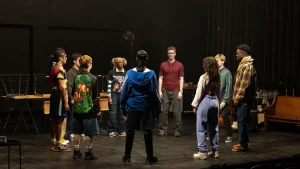
As a pair of collaborators, we were very, very, very conscious of not replicating any of the fictional violences inside of our room. We wanted to make sure to be as conscious as we possibly can to create a room that was free of that. And in order to do that, I had to be very actively transparent in my ideas around the play and how I was implementing them as a director.
Ronald Peet, who plays Asa, is a collaborator of mine, and we met weirdly and surprisingly at Playwrights watching a show. We were sat together, just the two lone souls, and we just started talking. That’s how we know each other. But I felt like I needed somebody, an actor who I could journey with — we had to share a brain in a sense, in terms of the ways in which Asa navigates. I couldn’t feel self-conscious of Ronald needing to analyze and examine me, and my techniques, and how those techniques might be helpful for Ronald. And I also had to be aware that Ronald might mimic me in some moments. But look, I think that at the end of the day, I made a decision that Asa is a good director, and a good actor, a good artist. And actually, furthermore, he’s a great artist.
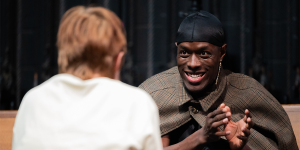
When I made that decision for the character, it meant that then he had to be believable, and also had to actively use tools that directors use. And these are tools that we, directors, as artists, and as makers, these are special tools that we have, and instincts that we have. A director has to be able to read a room, has to be able to acknowledge that an actor is bringing this in, or has to be able to understand and analyze human life in order to put that life force inside of a production, and how you bring that, and how you give that, how you make that, how you personify that, right? How you take a text from the page into a space.
What Asa does is use those skill sets that they have as a great artist, and they use those skill sets for violence and for manipulation, and they manipulate those skill sets in order to create this piece of work. But the skill sets are the same.
So when you ask about how do I direct the director, I had to be able to break down the process of directing, and make transparent for everyone in the room really what the director was, what a director may do, and find out which tactics, which skill sets Asa has, and then figure out how Asa manipulates them. And then figure out what is conscious and what is impulse. And that journey was a long journey that continued through preview processes to understand really quite deeply what Asa’s drive was.
And that’s why I said that Ronald and I had to share a brain, because I also had to, not from a character perspective, but from an internal perspective, find some understanding of Asa’s drive in order to identify how the manipulation of those skill sets, which I have, and that I’m trying to build an artistic practice with, how those skill sets, when attached to Asa’s drive, might be used. Yeah. So that’s kind of how we broke it down.
KP: Speaking of your directorial process, I’m curious if you feel like you have a habitual “way in”? Is there a particular element of design that you connect to more than any others? Or is it really the text that is the most compelling part of a project’s early stages? And also as a complement to that, I’m curious now, having heard your previous answer, if there are any ways in which this show has, in its re-examination of your techniques and their application, changed your directorial approach going forward?
KTO: Before I was a director, I spent a lot of time as a musician. I was a classical oboe player since I was 14 and have played the clarinet since I was seven. Then I ended up getting a degree in jazz vocals. So I think that rhythm is a really big part of my process. A really big thing that I understand is internal pulse.
Even though that first act has no scoring, it’s very scored in terms of the choreography, the lights, the way the lights relate, the relationship between the lights and the movement. I think you can see, if you know I’m a musician, the musicianship in the second act where everything feels like there’s a rhythm to it. I often say as a director, I am operating as a jazz musician.
That’s how I direct, an internal feeling, a pulse. It’s listening beyond language and listening through language that exists outside of linguistics. And then figuring out how that language and actual text are going to live together. Because text is important, of course. (laughs) And so that’s what I hold on to all the time, an internal feeling. But in order to get to that internal feeling and really be able to listen with that sensibility, I read that script so much. I do a lot of technical work on it, trying to understand what the events are, what they’re like, doing all the math. I use this methodology of jazz singing. If you want to be able to improvise, you need to know the head of the song through and through. You need to know the way the chords work. In order to know those chord structures, you have to know all the modalities. You have to know all of the scales that can be applied to that score’s chords.
I have to do all of that very rigorous understanding of the text, understanding the beats, understanding where Naz is coming from, understanding the technicalities of the work in order to then, when I’m in rehearsal, when I’m in design world or in tech, now I’m improvising. I’m responding to vibration. That’s my internal process.
To answer your second question, I come from the tradition of South African theater making, which is one of company work. So the work that we see on stage is not unfamiliar to me, that’s generative work. It’s something that I’ve always admired. I had a company once upon a time for a little bit, being a 25 year old and making really impulsive, young work and working with a company of actors. I think for a lot of theater makers, that is how we come to it. But particularly for South African theater makers, it’s really part of our tradition. It’s a part of how we as this generation of makers have been brought up through the ancestry of the theater makers that came before us.
Sometimes directors, we are trained to know everything and there’s a level of control that we perceive that we must need. If we have any sense of failure, that control, that trust is gonna be broken. That is an outdated way of thinking. As a new generation of theater directors, particularly, I think that we have to challenge those ideologies. Since coming to the US, I feel that I have challenged that, but every director has engaged with tactics that they might not even have known were harmful at that time. Since Practice, I’m just navigating the world knowing I’m going to make a mistake in some room at one point in time. And I’m not fearful of making the mistake, I’m fearful of not being conscious of making the mistake. That means that the consciousness around it is much more important to me than avoiding some sort of failure.
KP: I was really struck by the ambiguity of the ending of the play and the way in which the final act is so explosive and then that concludes and we’re left with this really quiet and intimate coda to the piece. And without spoiling too much, I’ll say that it struck me as a really strong meditation on the cyclical nature of theater and the inherent repetitiveness of the form — for better and for worse. I’m curious to hear your perspective on that?
KTO: You know, we nearly cut it as a gesture. It was a conversation. We’re like, do we need it? Do we not? I don’t get emotional watching the show, but watching that coda is the one thing that a lump comes in my throat because I feel like Keeyon in that moment is so committed to the rigor of this act. You can sense the love that he has for this form and the love that he has for performance and the love that he has for art making in that moment and his desire to perfect it and his desire to really just be inside of it, even through the violences that we witnessed before that. And we watch him find some sort of freedom from that, but we also watch how that freedom then takes over the body and veers towards something more… there feels a little bit of an edge to it. There’s a sharpness to it inside of his movement. And I think that in that moment, what I was hoping for was after a whole lot of language, like really a ton of language, a ton of text, and also sitting with the show for, at that point you’re sitting with it for two hours and forty minutes, right? After you’ve sat with that, with all of that text, with all of that theater, sitting then inside of something that feels beyond language and is in the body is visceral.
And in that viscerality is an attempt to express the metaphor of the show, which is, I think, what Keeyon is going through at that moment. And that’s what I received from it. On the page, it’s very different to what we did for the production. On the page, there’s a little bit more rigor to it. And I felt like I had to put the pages aside and make with that particular actor that we had. If I had made it with a different actor, it would be a different thing.
That’s really how he and myself and Camden [Gonzales], the movement director, how we understood that together. He’s taking ownership of that in his body. And then the mundanity of forgetting a water bottle and having to start a show. So the real beautiful epicness that we’ve committed to as theater artists is to try to reach something that feels divine and something that feels beyond ourselves, but also the mundanity of the ways in which we do that. Those things are what in the coda I was hoping to evoke. The ambiguity of the ending is frustrating to some people and for other people, they understand it from an intellectual space. But when I watch it, it gets me in the middle of my chest because of those things that I’ve mentioned.
KP: This play is so much about power. And, obviously, there’s an entirely different conversation to be had about the vectors of financial power in theater and the exertions of producers and that whole machinery. But outside of that arena, I’m curious to hear from you because the play was really asking this question of me as I was watching it, which is who do you feel holds the most psychic power in the theater?
KTO: I’ve been in rooms where that power has shifted based on a lot of different circumstances. If we’re talking about commercial theater versus not for profit, versus self-funded theater, I think power takes a different form. And I don’t know if I can articulately answer who I think holds it.
Naturally the person who runs the room holds an authority that gets to decide and influence the culture of the room. And that is not always the director because the director is not always running the room. I think that the American theater has a flaw, that it has a hierarchy because it’s quote-unquote driven by the playwright.
And therefore, once we start having that sense of the text is the most important, we allow ourselves as theater makers to create a system where power can be ordered by one point. I’m not saying that the playwright is the person necessarily, but I remember someone said to me once when I got here “the text is king”. And I was like if something is king, then somebody gets to wear it. And that’s not the making philosophy that I come from, that’s not how I understand theatre. I understand myself as a director as an equal artist to everybody in the room, I just have a different skillset that I’m providing to the creation. Probably the theatrical system as it exists holds the power, because it allows for individuals to manipulate it to their whim. If there’s a celebrity actor in the play, that person is holding the power regardless of who the director is, but that’s in relation to commercial work, but that’s what I’m saying, it’s a system. The Western understanding of theatre means that there is a hierarchy of power, and that’s also true of Western society.
ONE MINUTE WITH MELODRAMA
FAVORITE PERFORMING ARTS VENUE?
KTO: The National Arts Festival at Makanda in the Eastern Cape in South Africa. It’s a festival, it’s where I saw the best work I’ve seen, ever.
FIRST SHOW YOU EVER SAW THAT YOU REMEMBER INSPIRING YOU TO BE A PART OF THIS WORLD?
KTO: Very strangely, it was Carousel, I was in Carousel when I was eleven. I played a Snow child, and I would be able to watch the “If I Loved You” scene which is right after the Carousel opening overture, all the other children had to leave, but the stage manager let me stay and stand next to her, and I’d watch that scene as an eleven year old from the wings and just be completely in awe everytime I’d go on, it’s the thing that made me love theatre. And it was a community theatre production but it was at the big opera house.
FAVORITE PLAY YOU’VE DIRECTED?
KTO: Practice comes very close. I don’t know, I think they all contain pieces of me at different points in my journey. I can’t do a work if I can’t put pieces of me inside of it. One of my favorite things I made was an adaptation of Three Sisters that I did at school, at Columbia, where it felt for the first time that I saw the things that were in my mind, I saw the things that I was trying to do, and I was like, that’s what I wanted to do, and it gave me permission to break the rules that I broke in order to get to that place. But also taught me reverence, reverence for the form that I don’t think I had before.
MOST RECENT SHOW YOU SAW?
KTO: Last night I took my parents, my mom and aunt to go see Buena Vista Social Club. Then I saw Prince Faggot because I felt I needed to go and see it.
IS THERE DIRECTOR WHO INSPIRED YOU EARLIER IN YOUR CAREER?
KTO: There was a group of South African artists, South African directors: Mandla Mbothwe, Phillip Rademeyer. Penny Youngelson, Tara Notcutt, Jay Pather, and Mwenya Kabwe. Those people were the creators who gave me permission through watching their work to really think about my expansiveness as an artist.
ANY PRE-SHOW RITUALS?
KTO: Oh, it really depends on the show. I used to want to sweep the stage. But because of labor laws and unions I can’t do that anymore. I felt like since working in more established theatres, it is someone’s job, trying to insert myself in it has felt like an inconsideration of their skills, of the stage manager, crew’s role in the play. But now it’s a lot of listening to the space, and just sitting in the space, and just looking at the space and feeling the space. And then the silly one is that I have to have Twin Snakes Haribo gummies, so I can pull it, so that my frustration with whatever is going on can go out in the Haribo. And I have a stress ball with me also, which I use. Those are the three things which I have now grown accustomed to doing. I just have to put that energy into something that is not the space. Here’s this inanimate object that is going to get energy, because oftentimes that energy is not about anybody, it’s just about me. Or this Twin Snake is going to get pulled, and then, (laughs).
Production Photos by: Alexander Mejia
Share a commentWe’d love to hear your thoughts
You must be logged in to post a comment.