
 My Melodrama

 Catch while you still can
From Flash Mobs to Opera: Meet Colombian Soprano Julieth Lozano Rolong
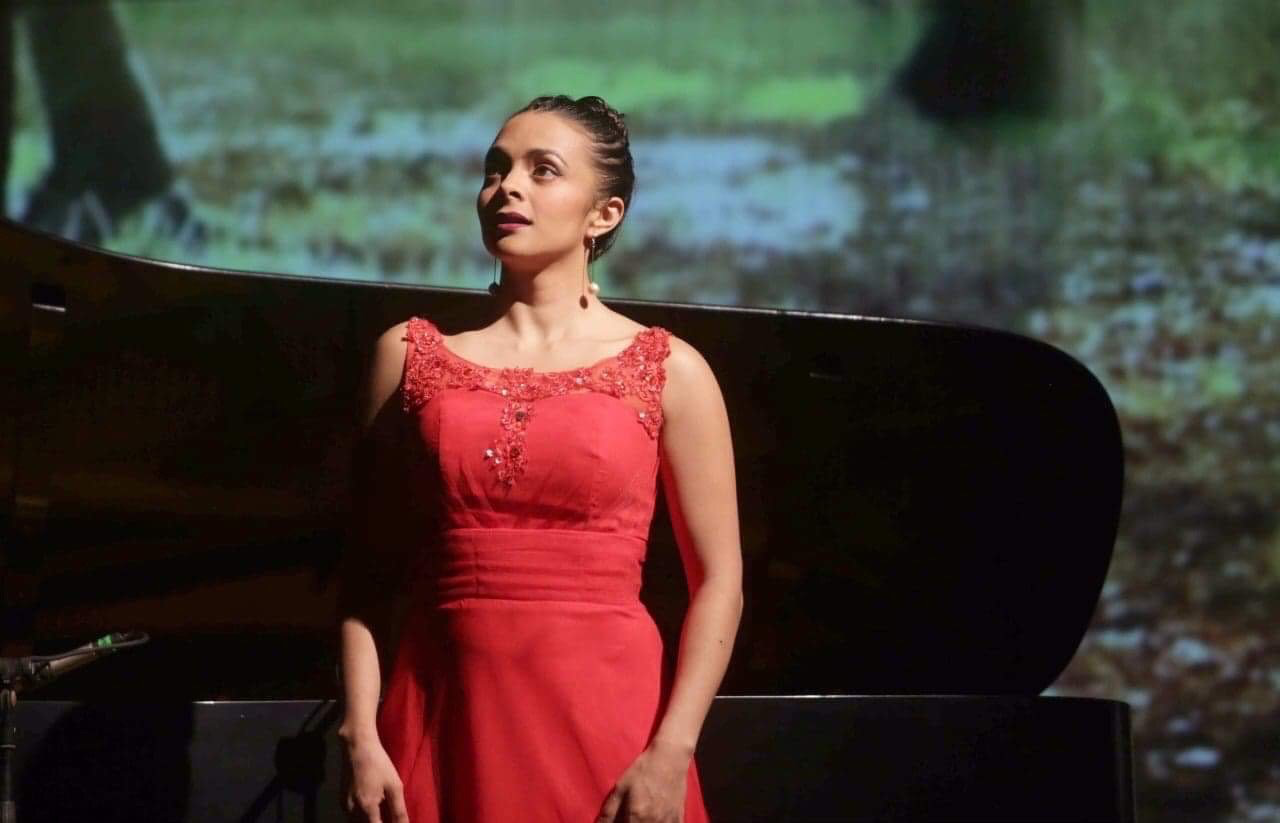
Opera found Julieth Lozano Rolong by accident—and she followed it all the way from Colombian flash mobs to international stages. Calling in from rehearsals in Glasgow, the expressive and wildly talented young soprano talks Louise Snouck Hurgronje through her joys, doubts, representation, and why opera doesn’t belong to one place.
Not liking every opera, Julieth points out, is hardly a failure of taste—“It’s like going to different restaurants—you have to try a few before you know what you like,” she says. She’s currently working on a world premiere with The Scottish Opera and preparing for a London recital with the charity Opera Rara at Bechstein Hall next month, for which she will sing Schubert alongside Latin American songs, showing us that classical music “doesn’t have to be so stiff!”
 london

Julieth Lozano Rolong: Hello. Can you hear me?
Louise Snouck Hurgronje: Hi! Yes, I can hear you!
JLR: Sorry, I was having some issues with the link.
LSH: It’s always chaos. Whereabouts are you?
JLR: I’m in Scotland in rehearsals for a new production which is super, super fun.
LSH: I heard about that. You’re in Glasgow, right?
JLR: Yes in Glasgow!
LSH: Scotland is probably one of my favorite places in the world.
JLR: I agree. It’s a lovely place. It’s crazy in winter, but the people are so nice, and there’s so many things to do.
LSH: Yeah, the Scots really are so genuinely friendly and interested. Anyway… can you tell me a little about how opera entered your life? I mean, is it something you sought out? Or did it find you?
JLR: It really was actually a series of fortunate events. I grew up in a family where opera and classical music was just not a thing. It wasn’t something that you were put on in high school either. We had a chorus at my school but we sang traditional Colombian music. Actually it was through someone that heard me sing at church. I used to play the guitar at my church—I’m not religious anymore, but at that time I was very religious—and one day the singer got ill and I was like I’ll sing because it’s for the church, right? And someone really liked the way I sang and convinced me to take a lesson. Then that lesson took me to another lesson and another lesson. All of this in traditional Colombian music, never classical music.
LSH: Wow.
JLR: And eventually my situation, my financial situation got me in a place where I couldn’t pay the lessons anymore but thankfully the university where I was, where I already had a loan to study engineering, offered the chance to do a second degree for the same price. Two for one! And I was like well I already like singing so I might as well do it properly. So I signed up for voice and I auditioned with a Colombian song. I remember they asked me, “Are you sure you know what you’re signing up for?” And I said, “Yeah, for voice.” And then the first lesson I realized that voice meant classical singing, which I didn’t know. It was just a coincidence of the world.
LSH: Oh my gosh.
JLR: Yeah.
LSH: It was an accident!
JLR: It was an accident because the traditional Colombian music that you study in other places, you have to sing under jazz. How on earth would I know? I just signed up for voice and it was the most beautiful accident ever because it’s guided me singing for about 12 years now.
LSH: I’m already so excited to go and listen to some Colombian traditional music after this because I’m not entirely sure where to place it…
JLR: Oh, the difference is massive. And I have to say that I didn’t know I was good. I actually thought I was really bad because everyone around me told me that I wasn’t a good singer. So, I believed them, but I did enjoy it. So, I thought, I’ll do it just because I like it. It makes me smile. So, I’ll keep doing it.
LSH: And does singing still evoke so much joy?
JLR: Oh my god. I have lived on a roller coaster with my singing. There are days where I feel like it’s the most beautiful thing that has happened to me. There are other days where I feel this heavy weight on my shoulders. I would say that’s mostly because of the business side, not the singing. Singing I have found to be my healing place, my community, my safe and sacred space.

LSH: I often think, you know, it must be so challenging for artists to balance being creatively free and to worry about earning a living and finding their way in the business side.
JLR: Yeah. When I started studying singing and at some point decided this was going to become my career, it was scary you know? Because I didn’t know how it was going to work. I didn’t have any examples, any guides. I knew that I came from a family of creative humans, so I thought there has to be a way. And if it all fails I’ll find a way to sell some empanadas, which is—
LSH: Of course I know empanadas! Delicious!
JLR: Yeah! So little by little I started building and started by working in flash mobs. It was one of the coolest jobs ever.
LSH: Flash mobs!?
JLR: I don’t know why, but it’s still a thing in Colombia. So for two years I did flash mobs,
LSH: Wow.
JLR: But I mean a lot is a lot. Like every week I was doing 10 flash mobs. It was insanity! Sometimes it was in a supermarket, sometimes it was in someone’s house.
LSH: Who was organizing these?
JLR: A wonderful woman called Adriana Rojas. She believed in me when no one else did. There’s one that we did that I will never forget—she brought us to this apartment of someone and said “you have to act as if you are the new girlfriend of the cousin”. So then I entered the house and was introduced to the family as the new girlfriend and everyone was like, “Oh my god, he has a new girlfriend. He’s never brought a girlfriend.” And I acted. I had a whole backstory and then suddenly in the middle of the evening I’d start singing! We also needed microphones so the challenge was to put the microphone on while you’re in the middle of a meal without anyone noticing. We did all of this for two years and it gave me so many tools: to act, to learn how to react and adapt without thinking.
LSH: I can imagine.
JLR: So this is one of the most important jobs I did.
LSH: Have you seen those flash mobs all over Instagram organised by that guy I think his name is Julien Cohen with all those different musicians!? He’s kind of bringing them back I feel.
JLR: No!
LSH: Oh, I’m gonna send them to you.
JLR: Send it please! So yeah, this is how it all started for me and then later on I realized that jobs are not going to find you. To some people they do. To some people they appear on a platter, but for most of us they don’t. So you have to go and knock on the doors.
LSH: So, I have parents who are obsessed with opera, but it always kind of terrified me. I didn’t get into it until about four years ago when I saw a production of Carmen in Amsterdam which had some 300 extras on stage and I was like “I don’t know what this is, but this is the most all-encompassing form of art I’ve ever seen”. But it is so easy to feel intimidated by opera because it feels like you need to know a lot beforehand or whatever. So what I’m wondering is, how did you approach this universe coming at it entirely new? How was your education around it?
JLR: Yeah I started from zero. The moment I decided that this is what I wanted to do I was already in my last semester of studying engineering. I already had job offers, but I was like this is not my thing. So I needed to restart. The first thing I did was to get a job in a chorus in Colombia. It was an opera chorus and honestly I had this tiny little voice that no one could hear.
My first opera was Tannhäuser, a Wagner opera. It’s epic music but I was not connecting with it so much. My parents came to watch and my Mom fell asleep in the first row—gone! Like, you could see her. And my Dad… I have never seen my dad like that. It was as if he was a kid in a candy shop. His eyes were wide open. He knew the whole story by the end. He told me, “But what’s going to happen with the dragon?!” He was so excited and I couldn’t believe it. The next opera I did was Turandot. Another one with hundreds of people on stage. This one touched my heart deep down but my dad fell asleep in the first row and my mom loved it. So then I realized that there’s an opera for everyone. You might not like a certain story but you might like this or you feel connected to these harmonies. It’s like going to different restaurants. Maybe you hate Greek food so then you go and try, I don’t know, empanadas and you love it! You never know.
LSH: That’s such a good point because I think what happens is that the genre of opera gets swept under the same rug and people are almost frightened by the word, but you’re not going to love all food as you say. So why would you love all opera?
JLR: Yeah, it’s very important that you give it a chance. And if you go and you don’t love it, that doesn’t mean that you don’t like opera.
LSH: Yeah.
JLR: It might mean that you don’t like that production. It might mean that you don’t like that composer or that you don’t like the performers. For example, my favorite opera is bohème and there are so many productions of it. There is a bohème on the moon, there is a bohème in old Paris, there is a bo-
LSH: Just checking you mean La bohème?
JLR: Yeah!
LSH: Cool, please continue!
JLR: A new director can put the same opera in a totally different place so then you might hear the same music but see a whole different show. So you have to give it a chance and start to learn what you like.
LSH: You mentioned Puccini’s opera Turandot, we actually just published a story about the somewhat problematic nature of its story. The wonderful writer Kyle Turner concluded however, that the obvious fantasy of the production made it hard to resent its racial and cultural ignorance. This is a pretty central conversation happening in opera right now though right? Many will have heard about the female opera director Katie Mitchell who is retiring from opera because these stories are inherently misogynistic…
JLR: Yeah, 100%. I feel like there is so much opera that is sadly just pretty much a misogynist story. I don’t know if you’ve seen Così fan tutte —
LSH: Widely interpreted as “All women behave that way” right?
JLR: Yeah literally the name is so problematic. As much as you try to change and twist these texts—change this word or that word—we have the issue that it then becomes unnatural to the way it was written. I think it’s important to see certain things with the acknowledgement of why we’re putting them on. Are we putting them on to inform ourselves on how this was done? Or are we putting them on just for the fun of it? There’s so many new things that could be done, new composers to work with. The other conversation to have is about representation, because for example, we have these characters that are written in a particular ethnicity, in a particular age and there are not a lot of roles written for a Latina that sings with my type of voice. So then I end up sadly playing stereotypes. I end up playing maids. So to a certain point I think that theater has to, and opera as a theater art, remember that we are creating fantasy. That I can go on stage and play a fox in The Cunning Little Vixen. Well, I’m obviously no fox.

LSH: I saw photos of that! Magic.
JLR: We cannot force people into a box based on how they look.
LSH: For sure.
JLR: And there are certain pieces that have a history that we have to be careful about. Like you’re mentioning one interesting example with Turandot which is one of those. It’s written by an Italian guy based on his perception of how things were in the east. A world that he probably never explored properly.
LSH: He didn’t.
JLR: So we have this clear situation which is not living in that world. It’s another sort of fantasy world where we have to be mindful of how we portray certain people, certain races too. I’m now working on a production of The Great Wave,
LSH: I know this is what I wanted to talk to you about! It’s a new opera,
JLR: Yes, it’s a new opera and actually that was part of my first concerns because it’s the story of the Japanese painter Katsushika Hokusai and I was cast as the daughter of Hokusai. So again, I’m a Colombian. I’m a Latino. What do I have in common with the character of Ōi, a Japanese painter that lived in the 1800s? Well, not much if you look at it like that. So the first thing I did was to approach the composer and ask what his plan with this was. Where are you setting it? How do you want the characters to look? This is very important because I’m not going to go and pretend I’m a different race to play a role. What’s the motivation underneath the role? Why are we doing this? And why are you casting someone that is so far from this culture? And their response was very interesting, the creative team wants to clearly portray the union between different cultures, the communion between artists from everywhere in the world. They want to showcase that art, in the way that they see it, is inside us. And once we are stripped of our skin, our hair, our arms, all of this inside-we’re all the same. So now in this particular production we have a family on stage that is a grandson from Africa, mother from Australia, daughter from Colombia, dad from Japan.
LSH: How beautiful to present a global family like this on stage, especially now!
JLR: Oh, it’s amazing. I’ve had the most wonderful time. This is my second production with The Scottish Opera. The first one was Ainadamar and also that was another kind of big collaboration of multicultural artists. In their upcoming season they have more new commissions, new collaborations, new living composers. They are truly believing and investing in that.
LSH: Can you share a bit about how this opera is inspired by the iconic The Great Wave off Kanagawa woodblock print that I think nearly everyone will have seen in at least one form once in their life?

JLR: Yeah this particular one is epic because it’s a piece of art that everyone has seen. So, we’ve been kind of collecting all the places you can find it. It’s absolutely everywhere, on tissues even! We are literally diving deep into the life of this wonderful artist and everyone surrounding them. It’s very very cool.
LSH: It must be a crazy ride to translate an artwork into an opera. Do you think new productions like The Great Wave are the future of opera?
JLR: I hope so. I also did another project recently. It was in the Tate Modern. A project around Carmen, but it really was not Carmen. So since you’ve watched Carmen,
LSH: Yeah?
JLR: This was not that. It was inspired by Carmen and the life of Picasso. So the project was called Theatre Picasso,
LSH: Oh, but this exhibition is still on! I’m dying to see it.
JLR: Exactly! And for the exhibition, we did a collaboration with one of the curators,
LSH: Who’s that?
JLR: A wonderful artist, Wu Tsang! It was so beautiful how she looked into this new world of opera and said let’s break all the barriers, create art and use opera as part of this collaborative creation. Not this thing that is separate from us on a stage. So I feel like the future of opera is in creativity and in collaboration, in uniting this art for what it is. As you said in the beginning, this is absolutely a magnificent union of different arts. So I hope that this continues and there are new stories everywhere to tell.
LSH: And then lastly, we were connected through Opera Rara and you’re performing with them in London at Bechstein Hall next month right, which is quite a new venue, isn’t it?

JLR: Yes. Opera Rara is like my family and our upcoming recital has been a refreshing breath in a business that sometimes feels boxed. They have offered me a beautiful platform to reach new audiences and to create those bridges between cultures that classical music, in my opinion, deeply needs.
LSH: I looked at the program and saw that you’re indeed bringing together music from all these different countries and centuries. From Germany to South America. A crazy cool mix.
JLR: Yeah. I always wanted to, I mean since I started doing this profession, I always wanted to show that it doesn’t have to be so stiff. I remember there was one thing someone told me: “you will never make a living from European art because you’re not from Europe” and this was so hard to hear. It kind of hit me like, wait, is opera a European art? And it kind of stayed in my head like that. And then in the past 10 to 12 years of my career I realized that maybe there are some things particularly of opera that have started in this particular continent, but it’s an art that is universal and it belongs to all of us. So I wanted to unite those things that inspired me from Europe, Schubert for example is one of my favorite composers. My German might not be the best but it’s the music that made a flame here [touches heart]. So I wanted to put that next to other things that also move me deeply because I’m not a separate artist, I’m not a different person when I sing opera. When I’m putting on a recital, I want to showcase my artistry which combines those worlds. And I thought it would be nice to literally put Schubert next to a bunch of Latin American songs in different way. There is one that I’m going to be playing just by myself on the guitar that I’m sure is not very common but it’s a way for me to truly share my honest art that is not trying to be someone. It’s just showing who I am as an artist.
LSH: Oh, I think that’s the perfect note (excuse my pun) to end on. And I really hope to come to this concert.
JLR: I hope so, too.
Share a commentWe’d love to hear your thoughts
You must be logged in to post a comment.