
 My Melodrama

 Catch while you still can
CUTTING, ASSEMBLING, AND BUILDING WITH SET DESIGNER SABINE THEUNISSEN
For over two decades, the Belgian set and exhibition designer Sabine Theunissen has been the close collaborator of renowned South African artist William Kentridge. While his expansive practice wanders across film, drawing, and sculpture, it is their partnership on the stage that has produced some of the most strikingly imaginative productions in contemporary opera.
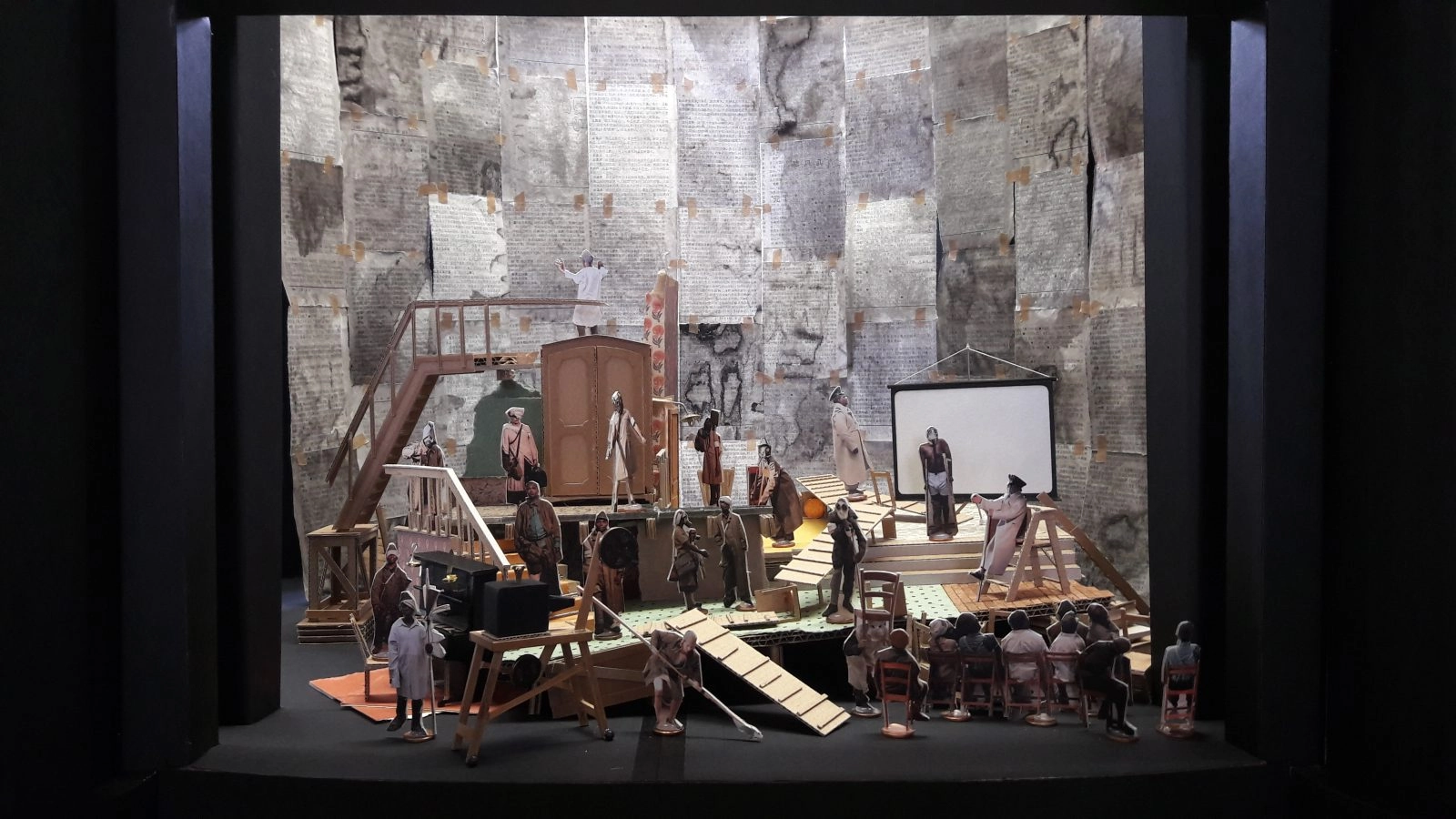
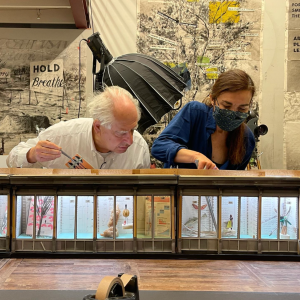
In an era of digital renderings, Theunissen remains devoted to the physical scale model; hand-built cardboard structures that serve as the “physical core” for every production. Before a project, she will build the model in her studio in Brussels and then travel with it (they are designed to fold up!) to Kentridge’s studio in Johannesburg, where it serves as the central point of the creative process. She describes a workshop environment where the team (costume designer, video editor) gather around her large models to build the universe of a show within it.
As Theunissen and Kentridge prepare for their debut at Glyndebourne—the historic opera house nestled in the glorious English countryside of East Sussex—this summer with a new production of Monteverdi’s L’Orfeo, the designer talks about a shared visual language with Kentridge and the wonderful way she is able to visualise the set at the start: “When I listen to the music, I see images in my head,” she explains. “I know if it’s turning, lifting or collapsing. It’s like walking in a dark forest until your sight adjusts and you find the mystery.”
Book your tickets to see L’Orfeo now for a magical summer’s evening.
 london

Louise Snouck Hurgronje: I would love to start at the beginning and ask how you became an architect and then designer.
Sabine Theunissen: I was trained as an architect to start with. But I have always been interested in theater; my dream was to somehow be in that world. After my studies, I spent one year in Milan specializing at La Scala opera house and when I returned to Brussels, it was clear that I wanted to work in the opera field. Then I got the opportunity to join the team of La Monnaie in Brussels and I worked there in-house for 17 years! That was my school, really. Where I learned my practice and how everything functions: the priorities, how the artistic part connects to the technical and practical parts, and the budget and safety—all these questions which are equally important for a project. That’s where I learned about this, let’s call it a “human machine,” and that’s also where I met William Kentridge.
LSH: At La Monnaie?
ST: Yes. He came in 2002 to revive a production he had done a few years prior. By coincidence, I was in charge of that work. He was preparing a new production of The Magic Flute at the same time and looking for someone to support him because he wasn’t familiar with the technical side of opera; he needed someone who knew the house and knew about design. That was our first collaboration and we never stopped working together.
LSH: It’s very special. What was it about his universe and visual language that excited you then?
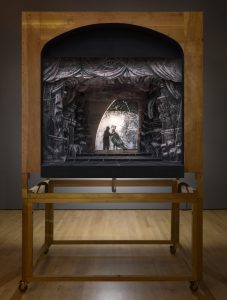
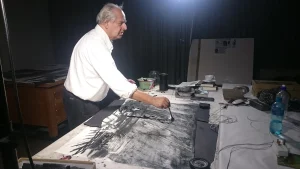
ST: To be completely honest, I didn’t know his work at the time, which probably helped because I had no preconceived ideas. I think he was also interested in someone who was not a renowned, independent set designer, but someone who could bridge the technical and artistic parts of the project. Very soon, it became a real collaboration in terms of ideas and vocabulary. He was interested in the visionary and political parts of the production and wanted to situate The Magic Flute in the Enlightenment; the Victorian era. To explore the colonial questions of light, science, and wisdom versus darkness. He wanted to see the cracks in those antagonisms. He placed it in the world of early photography, using the negative and the positive as a way to enter these questions. The set was like a black box based on old cameras; it was somewhere between a Baroque set and the inside of a camera. All based on this idea of photography with two projectors—one in front and one in back. It was very precise geometrically in terms of optics, sightlines, and shadows. I traveled to Johannesburg with a large model and we started working in it immediately. That’s how we always work: I bring him a big model and we work inside it with projections. He draws on his table, and simultaneously, what he draws is projected into the model so we have a sense of how to play, combine, and respond to surprises.
LSH: Do you still make these models yourself?
ST: Yes, for sure. That’s what I love most.
LSH: When you say “big,” how big are we talking?
ST: That one was 1:10. I use different scales; I start with a small model just for me to think. I’m not a person who draws much; I’m more about cutting, assembling, and building. I need the physical support to trigger my brain. Once we agree on a starting point, I develop it to a 1:10 scale—meaning 1 meter is 10 cm, and a person is 17 cm. We build that model in William’s studio and he keeps it to create his film. It is the physical core that everybody gathers around. Even the video editors work in front of the model. The costume designer makes little figures that go inside it.
LSH: I love this image of you all gathered around your models. It’s a very rare way of working, isn’t it?
ST: Yes, more and more so because people now prefer digital models. They are precise and the rendering is amazing, but it’s just not for me. To me, it feels flat, it’s just an image of a model. I like to work with my hands, to touch and move things. I realize I need that physical approach. Even for exhibitions, I start with a model. It’s a good way to learn the building, the scale, and to feel the space. It’s not a mental process; it’s physical and organic. For my team, it grounds the project and makes it less abstract. My models are all foldable, so I can pack them flat and travel with them in a suitcase!
LSH: I was about to ask how you got them to Johannesburg! So at what point are the projections made onto the model? Do you film the model to show on stage?
ST: That’s another level. Sometimes we have a “model in the model.” For L’Orfeo, for example, the film for the underworld was shot in fantasy models that I built—tunnels, train stations, machine engines, or an infirmary.
LSH: Yes! You are currently working with the Kentridge on a new production of L’Orfeo at Glyndebourne this summer. How did you come up with this universe of the underworld for this story?
ST: Through many conversations with William. He created strange creatures with tools, so we were inside a big boat or a machine. He said, “We need a long journey,” so I knew how long the sequence must be. I know the music, the story, and his creatures, and I propose things. I’m quite freestyle. The spaces are flexible. Transitions are super important; it’s like dancing together. We bring each other ingredients, and William does the final mix.
LSH: What is your favorite part of this journey?
ST: I love to create models and see them transformed into a film at the end. Every step is interesting, but passing from the model to reality is a long process involving safety, budget, and capacity. We have to find solutions without losing the strength of the original model.
LSH: You mentioned knowing the music, is this music that you love to listen to?
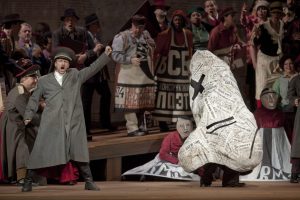
ST: For L’Orfeo it was easy because I love the music, but we have worked on much more complicated operas like Shostakovich. The first time I listened to The Nose, it was not easy. But once you put images to the music, it becomes clear. I’m a visual person. When I listen to music, I see images in my head: I know if it’s turning, lifting or collapsing. It’s like walking in a dark forest until your sight adjusts and you find the mystery. You learn to love the music by recognizing its identity.
LSH: So when you start a project, do you take a walk and listen to the music and see where it leads you?
ST: Yes, it happens. I like to listen alone first and read the libretto to let the music impregnate me without thinking too much, just to see what it suggests.
LSH: This is your debut at Glyndebourne, isn’t it?
ST: Yes. I have never been there before, not even as an audience member.
LSH: It’s such a beautiful pastoral setting. It’s a special evening because of the walk the audience takes through nature, enjoying a picnic before or during the show. Has that influenced your creation?
ST: It’s like a dream to be there! For William, it was very exciting. We had to imagine the opera with this specific interval, and I would say that interval influenced the way we built the piece. The team in Glyndebourne is amazing—very supportive and open—so I think that quality will be visible in the final result.
LSH: Is it exciting to see how audiences respond?
ST: It’s a stressful moment for me… I’m so aware of everything that could go wrong. Every single second has to be over-prepared. It is like a big clock with so many layers—singers, video, lights, scene changes—and it all has to be under control. You just hope for the best at the opening. It’s hard to relax.
LSH: All in the beauty and wonder of live performance!
ST: Definitely!
LSH: Do you still go and see shows yourself?
ST: Yes, when I can, though I travel a lot. I love to go to the theater and the opera.
LSH: When you do go, do you seek inspiration from other people’s work?
ST: When I go to La Monnaie, I’m always happy to see my ex-colleagues and see how things were built. It’s hard for me to just be a regular audience member…
LSH: I can imagine! You have a core team together with William that has been together a long time right?
ST: Yes, we work with the same costume designer, light designer, and video team. There are about six or seven of us who have worked together since 2002. It’s always the biggest joy to reunite on a project.
LSH: And how do you continue to surprise each other after so long?
ST: There is a lot of trust. William is magic at putting people together; he couldn’t do what he does if he worked alone. He trusts his team and likes to be surprised, so he leaves us a lot of space to do things he wouldn’t expect. He pushes boundaries by trying new techniques or going where he’s never been before. We usually have two big workshops together where we can experiment without the pressure of a result. Because there is no pressure, it’s always interesting and we have fun.
LSH: It sounds like a very special partnership. Thank you so much for taking the time to talk.
ST: Thank you. I hope to meet you in Glyndebourne!
LSH: I will be there.
Share a commentWe’d love to hear your thoughts
You must be logged in to post a comment.