
 My Melodrama

 Catch while you still can
CAMILLE ASSAF: THEATRE AS RESISTANCE
An encounter with the costume sketches of Rococo artist François Boucher in the Bibliothèque-Musée de l’Opéra (Paris Opera Library) shifted Camille Assaf’s path from theory (philosophy) to practice (design): “At that moment everything came into focus.” After training at the Yale School of Drama (years she calls “incredibly formative and also sobering”) and assisting the legendary Japanese designer Eiko Ishioka for the Beijing Olympics Opening Ceremony in 2008, Assaf has built a varied and revered career. A career, which is marked by a deep dedication to research and collaboration with illustrious directors like Peter Sellars and choreographers like Benjamin Millepied.
In a moving conversation in which Assaf talks about the theatre as one of the last true pillars of cultural resistance, MELODRAMA talks to the Paris-based creative about her costume craft and concocting characters.
 london

LSH: Let’s start at the beginning! Where are you from? And do you remember the moment that you knew you wanted to be a costume designer?
CA: I was born and raised in Paris. I inherited my passion for music and opera from my mother, a French musicologist and pianist and my passion for art history from my father, an American translator from New Orleans. I started drawing in my school books as soon as I could hold a pen (I even got expelled from a few classes because of this). I was mad about costumes, fashion and playing dress-up. I taught myself how to sew as a young teenager. However, in the very academic environment in which I evolved, doing something with your hands as a profession was sort of a blind-spot. I was not aware that there was even such a job as costume design before I wrote my Bachelor’s dissertation in philosophy (subject, the body in French baroque opera). While researching in the collections Paris Opera’s library in the Palais Garnier, I discovered the big old books in which costume sketches for the very first French operas were consigned. They were signed by Jean Bérain, François Boucher, Louis-René Boquet, and at that moment everything came into focus. Drawing, fabric, stories, and music equaled perfection. I must do that. I switched from theory (philosophy) to practice (design) within 6 months. I applied to grad school with a portfolio of drawings and pictures of costumes I had made for my younger brothers and sisters, and miraculously got in.
LSH: I believe you studied at Yale School of Drama, were these formative years for you?
CA: Yale was incredibly formative and also sobering. I arrived with all sorts of clichéd ideas about what shows needed to look like; I had been spoon-fed a specific taste. In 80s and 90s Europe, Robert Wilson was our god and everything needed to be angular and conceptual. Everything was a metaphor. Of course, coming from philosophy, I liked the idea that a costume was also a concept. But basically, I was incredibly young, raw, and superficial. Yale Drama taught me to read the text, it taught me to collaborate with other artists, and that theatrical design is all about solving concrete problems. Where does she enter? Where does she put the gun? How does the dress come on? That costume design is about humans, characters, and life. And ultimately, it is a poetic language. A costume or a set does have to perform poetically in a network of signs, contributing to the impact of the whole work of art that is the production. It responds to a certain quality of performance, to a certain rhythm, to an atmosphere. It elicits emotions, awe, disturbance, excitement.
LSH: One day you’re creating sleek, contemporary costumes for LA Dance Project and the next you are making gorgeously detailed period pieces for the opera. I suppose that’s the wonderful thing about being a costume designer? That you are able to dive into different universes and experiment with all these different forms?
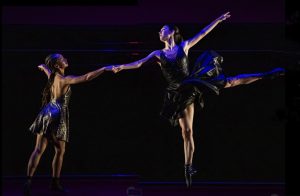
CA: Absolutely. Every new production is a completely new journey. Not only within the world of a play or piece of music, but also with your travel companions (the director, design team, performers). So each voyage is unique. But I feel like my job is to adapt to each specific destination and team. If I am going to [Jean-Philippe] Rameau with Peter Sellars, or to Romeo and Juliet with Benjamin Millepied, I am not going to pack the same way. But each time I bring my entire self. The work is different each time, because it’s the result of a specific alchemy. And what a joy, to be able to explore such different styles.
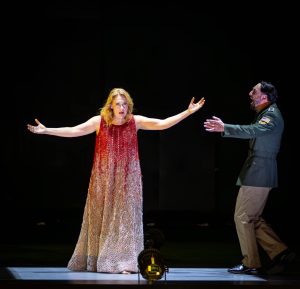
LSH: And is there a style or period that gets you most excited?
CA: The variety of approaches is what makes it feel so new every time. If it is a period piece, I am going to get very costume-nerdy, learn everything I can about clothes from a given time and place: materials, underpinnings, trimming techniques, tailoring. If what we want is something spectacular and visually arresting, I am going to invent lavish silhouettes in mesmerizing fabrics. If the piece calls for something raw; for a restrained, intimate feeling, I am going to spend hours getting to know each performer to find what feels most personal and truthful for them to wear. In the end, the costumes might be completely invisible; my work was elsewhere.
LSH: What is the first thing you do once you’re signed on to a project?
CA: Read the text, listen to the music, again and again. Live with it for a while. Reread, underline, take notes; a few words spring out. Then come the images. I make a pile of books and I spend a lot of time building a visual library for inspiration.
LSH: And what does the director’s role look like in this phase?
CA: Sometimes directors come in with a very strong aesthetic they want for the piece (for example, they are all wearing black), or for a costume in particular (they share an image, they want this dress for this character). Sometimes it is a lot more open and abstract. Each time, it is a creative conversation which can last for months. Our visions intertwine. And in the end, from all the images and words exchanged, silhouettes emerge.
LSH: Then you make one of your wonderful (are they watercolor?) drawings! Do you make these for each project?
CA: I am blushing! Yes, I use a lot of watercolor, some gouache, colour pencils, pens… If I can (if the time allows), I will always draw, even for contemporary pieces in which we are not building any costumes. Not only is it an integral part of my process, to get a feeling for the world we are creating, but I find it incredibly useful to communicate with artists and ateliers. It never stands alone, there is always some research with it, because sketches can also be deceiving, but it is where the piece gets its visual imprint.
LSH: You have collaborated with some epic creatives. Eiko Ishioka is among these, which I need to hear more about. You worked together on the Beijing Olympics and Grace Jones’s legendary 2009 Hurricane Tour right? How did you meet?
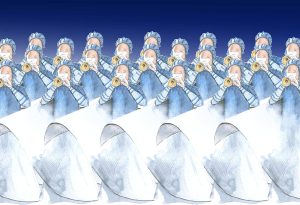
CA: Jennifer Tipton, Grande Dame of lighting design, who was also my teacher at Yale, introduced me to Eiko Ishioka in 2007, as she was looking for a few designers to help her with the Beijing Olympics ceremonies, which were huge. We worked for months, drawing hundreds of sketches for the Chinese Olympic committee to choose from. It was epic, and mad and enthralling, like taking a master class with the Michelangelo of costume design.
LSH: Is there something you learnt from Eiko that will always stay with you?
CA: Eiko encouraged an explosion of imagination, and was also so intransigent about beauty. She didn’t embarrass herself with realism in the least bit, including what it would take to make something she had designed. Sometimes she drove her collaborators crazy, just because what she was asking seemed impossible, but she also allowed everyone working on her designs an opportunity to explore their full artistry and push themselves beyond known boundaries. Everything that came out of her mind was a vision. She taught me to not be shy. When given an opportunity to design outside of an existing frame of references, I try to channel that wavelength.
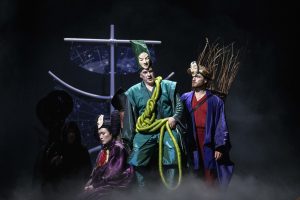
LSH: One of your most recent projects was the opera I Didn’t Know Where To Put All My Tears / Curlew River at Opéra national de Nancy-Lorraine? The production vision was heavily influenced by Japanese Noh Theatre, where did you begin with your research for this?
CA: The director Silvia Costa, who is a full artist and a designer in her own right, comes in with a unique, personal visual world to share. Almost paradoxically for a mind with such a defined aesthetic, she completely encourages the development of my own vision, so together we create worlds that can exploit the full potential of theatrical images. For I Didn’t Know Where To Put All My Tears / Curlew River, she had collected some old photographs of original Noh productions. The costumes in these were wild. In addition, we looked at Charles Freger’s photographs of vernacular Japanese festival costumes, from his book Yokainoshima, and also the works of fashion designers like Damir Doma, Yoji Yamamoto, or random images found on Pinterest or Google… It is a very eclectic mix of references. And then, the materials themselves yield their own language.
LSH: When it comes to working with great directors like Peter Sellars, what does your collaboration look like? How do you feel when an idea is right? Is that something you decide together?
CA: Peter Sellars approaches each new work with a strong idea of the deep meaning of the piece, but also a great openness to what it eventually will look like. So there is a lot of freedom to develop my own sense of the work. I think he likes working with artists who will bring in something unexpected, something he has not seen before. This means that many ideas of course never make it to the final cut, but that, in a continuous movement toward the truth of the piece, they remain an essential part of it. The show gets built as a contrapuntal piece of music, with several artistic voices intermingling until we finally land in harmony. We develop the work in advance through a lot of conversation, research and many sketched ideas. And then rehearsals start, and performers bring in their own presence, personality, interpretation, and that is when the costumes can truly find their full meaning. On Peter’s productions especially, I never impose a design idea on a performer. We continue searching, quite organically, until we find what feels right and meaningful and not artificial.
LSH: Aside from these wonderful people that you collaborate with, is there a performance house that you feel most at home creating for?
CA: Everywhere I have worked, whether in Paris, or Salzburg, Rome or Phnom Penh, Houston or Hong Kong, I have met with the most incredible human beings who belong to this family of theater-makers. Ateliers all around the world are filled with talent; drapers, embroiderers, painters, and metal-workers. Sometimes when leaving an atelier I have worked with closely for months, I can’t help but cry, as if I were leaving family members behind, for an unforeseen future. They are with me, wherever I go next. So I would say my home is at the theater.
LSH: I’d love to ask you what the joy is for you of working in the performing arts universe?
CA: The performing arts world is filled with people with large dreams and incredible courage. I don’t want to sound cliché, but the world we live in can be disheartening, appalling, and frankly scary. Violence is everywhere, mass-production and mass-consumption dominate, corporations are devouring individuals, techno-fascism is at our doors. Theaters and opera houses are among the few places where I see a form of resistance happening against the assaults of ideology. Because we keep searching against the logics of profit and domination, because it is where voices can be heard, and people are invited to reflect on humanity.
LSH: So true! And how do you see it evolving?
CA: We continue to dive wholeheartedly into Greek tragedy, romantic opera, or contemporary creation, because we believe that art can somehow make us better, that it can save humanity from itself. I am not trying to be dramatic here. Of course, it isn’t always what happens, and sometimes it fails, but at least we try. I don’t think the performing arts will ever disappear. History has shown us that it doesn’t, even in the darkest hours. The dwindling of funding for the performing arts we have seen in the past few years only tells us one thing: we need to keep digging in this tunnel, even when it means doing things differently; in the end, there is light. And this is also what I find in my colleagues: they are people who don’t give up. That’s exhilarating. I am also conscious of the privilege it takes to be able to even survive in the arts, and I know many artists who have had to take day jobs, or stop for a while and then come back. And that is also called resisting.
Share a commentWe’d love to hear your thoughts
You must be logged in to post a comment.