
 My Melodrama

 Catch while you still can
PAOLO FANTIN’S MONUMENTAL SHATTERED MIRROR ON LAKE CONSTANCE
Paolo Fantin is having a rather spectacular year. In February, he designed the Milano Cortina 2026 Winter Olympics Opening Ceremony, and this July will reveal his stage for the legendary and highly coveted Bregenzer Seebühne commission, which sits in the open water of Austria’s Lake Constance.
With this, he is tackling a completely different beast than the traditional theaters Fantin usually works in. The setting requires a monumental piece of high-tech landscape art which in this case took three years of development and a team of engineers to pull off. Fantin tells MELODRAMA about the thrill of building in dialogue with the natural landscape, noting that “there is absolutely no other place in the world that does this kind of stuff.”
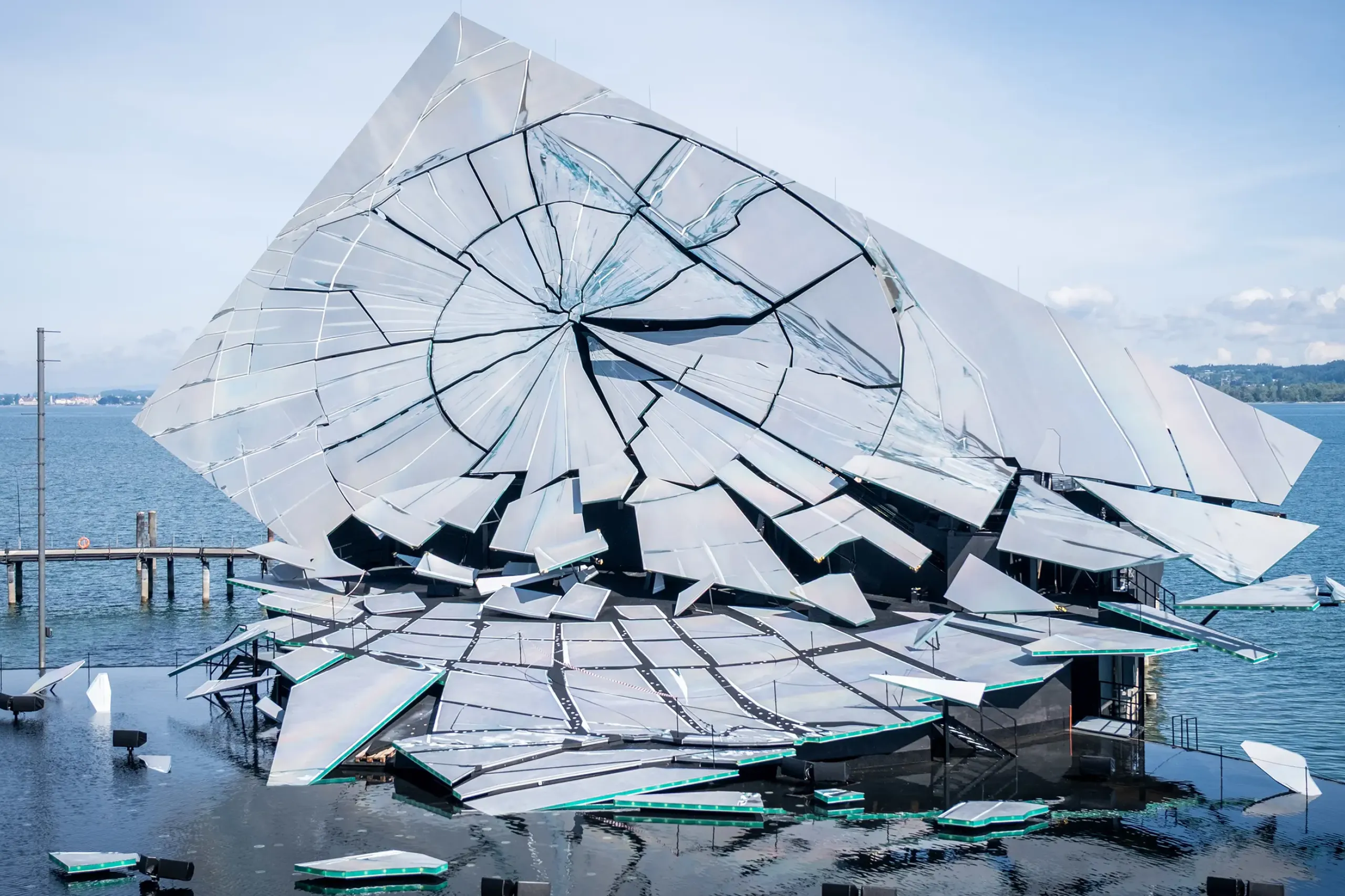
For this summer’s production of La Traviata, Fantin has anchored the opera around an idea he has carried around for nine years: a frozen moment of glass shattering over the water. “Violetta looks in the mirror, and the mirror gives her reality, which is the illness,” he explains.
image sources
- Seebuhne: Kristina Becker
 london

LSH: Hello Paolo!
PF: Ciao Louise!
LSH: I was thinking it must be heavenly where you currently are on Lake Constance.
PF: Oh yes, it’s beautiful!
LSH: Where do you usually live?
PF: Treviso. It’s a small city, really close to Venice.
LSH: Did you grow up there as well?
PF: Yes. I studied at the Academy of Fine Arts in Venice. My first theater was Rossini in Pesaro, and the second one was La Fenice.
LSH: Not bad formative experiences! So tell me, was it always a dream to design the Seebühne for the Bregenz Festival?
PF: Oh, yes. I am so happy to be working on this scale. I have an entire landscape to talk to, to create a connection with. It is very different from making sets for a traditional theater.
LSH: How did you go about establishing this connection?
PF: If you think about water, it is a mirror—a liquid mirror, basically. For a long time, I have had a specific image in mind for La Traviata: that Violetta, in the last act, is in a room surrounded by a cascade of broken mirrors. When I was asked to do this project, I thought immediately of this concept, which I’ve carried for eight or nine years. When you are in the middle of a lake, you have to create a massive metaphor. There has to be one singular image rather than a collection of props, because the more you put on stage, the less the audience understands. Realistic designs don’t really work here; this is closer to landscape art. You need a visual that speaks with the nature, but also contrasts it to create tension with the landscape around you.
LSH: It seems that you enjoy seeing your sets as living metaphors?
PF: I prefer to create spaces that speak about emotion, rather than just a physical ambient or place. My idea of a set is that it functions as another character in the opera—one that has a life because it has a beginning, goes through transformations, and stands alongside the singer as an alternative point of view. It’s for this reason that I love my job. I think that is the key when designing for a massive venue like this: you have to be spectacular with the sculpture, but keep the underlying emotion intimate.
LSH: Talk to me about the mirror and what it represents for you.
PF: For me, the mirror is the ultimate icon of Traviata. Violetta looks into the glass, and it gives her reality back—which is her illness. It’s as if we are trapped in her room; she looks into her reflection and realizes, “I know what my future is, and I know that I am alone.” Behind her, she has the men, the parties, the society rumors… but when she looks into the mirror, she sees only her harsh reality.
LSH: Are you a superstitious person? Because broken glass can conjure images of…
PF: No, I never think about that. For me, it is entirely about capturing that split second of reality. The mirror on the lake isn’t just statically broken; it represents the frozen moment of glass hitting and shattering on the floor. It is captured in mid-movement. We have a lot of moving parts suspended, which is something that deeply fascinates me: freezing a moment that the human eye cannot normally track. During the show, the pieces shift, and the slow motion of each mirror fragment follows Violetta’s story in an intimate way.
LSH: How long has this process been in development?
PF: Three and a half years, more or less—which actually ran parallel with my work on the Olympic Games. The process is completely different from indoor theater, so you have to think of absolutely everything years in advance. Everything is storyboarded down to the millimeter. You cannot simply arrive on stage during rehearsals and say, “Oh no, I want to change this.”
LSH: I’m fascinated, is the budget wildly different to ‘normal’ productions?
PF: Completely different. If you think about it, initially there is just a platform sitting in the water. It’s nothing—you have to build an entire world around it from scratch! The scale and the technology are on another level. Basically, we are building a massive sculpture that has to stay outside for two consecutive years through snow, sun, rain, and heavy wind.
LSH: So who do you have advising you on how to survive the elements?!
PF: Let me tell you, they have a specialized machine like an oven where you place the stage materials, and in just one week, it simulates the damage of six months of weather. It’s a learning experience that has pushed my career forward. It was the same with the Olympics; the overhead rigging system that flew the rings in 3D was incredible to work with.
LSH: I’m guessing you would call this a career highlight?
PF: It really is. When I was a student at the Academy of Fine Arts in Venice, I traveled here twice just to watch the shows. To be back here building one is incredible.
LSH: Another dream must have been checked off when you were asked to design the Opening Ceremony of the Milano Cortina 2026 Winter Olympics? Which, by the way, I was utterly obsessed with. Pure Italian theatrical wizardry.
PF: It was really another dream come true. The physical scale was quite similar to Bregenz, and because you are outside, you get to work with these incredible, heavy-duty fly systems. The way you deliver the show is entirely through pictures, because those images are what will stay in the mind of the audience—it’s what they go home with. It shouldn’t be simple, but it must be something the public catches immediately. Not too overly intellectualized, but deep and strong. I feel very good in this aesthetic way.
LSH: I love it when those two worlds come together. Sport and theater are actually very similar—it’s about a collective communion. What was the first thing that came to mind when you were asked to visually represent Italy?
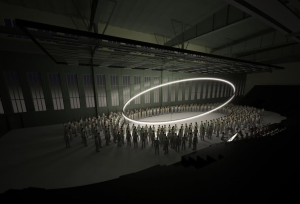
PF: The title of the ceremony was Armonia (Harmony). The spiral I designed was my very first instinct, and I trust a lot when an idea comes directly from the heart. The spiral for me is a symbol of energy and harmony, but not in a static format. It’s an image that continues to move, spinning into the center and projecting outward. It represents Italian creativity, which is never quiet.
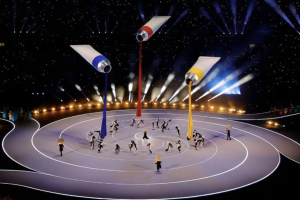
LSH: It’s alive! You worked with your long-time collaborator, director Damiano Michieletto, on both the Olympics and now for the Bregenz Festival. Am I right that you two have been working together for close to 25 years?
PF: Yes, since 2004.
LSH: It’s truly incredible. You don’t hear about that often—an artistic duo that is able to sustain a creative partnership for so long.
PF: Yes, it’s something that happened in a completely spontaneous way. We know each other so well, of course, and every time we collaborate, we try to push into something new. I never feel like we are repeating ourselves; it is a partnership that keeps growing. For me, the personal connection between people who work together is everything. I need to establish that connection, to understand the emotions of the people in front of me, before we can build anything.
LSH: So what has been your favorite part of the process of working together on La Traviata?
PF: This is an incredibly high-tech theater, and experiencing it was a real “wow” moment for me. The whole project was designed in 3D, so you can put on a VR headset to virtually walk on the stage and check all the different levels of the set before it’s even built. Managing the mechanics is a massive undertaking—we have 86 moving pieces on this set alone. It’s like a major engineering project; you need structural engineers and a huge team of experts. What surprised me most is that the technical team here is even crazier than I am! They love tackling wild ideas, and I think that is what makes this specific theater unique. There is absolutely no other place in the world doing this kind of work. Now, I want to expand my world beyond traditional opera. I love installations.
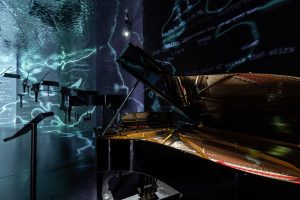
LSH: You just presented an installation in Venice at the Biennale, right?
PF: Yes, it is open until November in the Venice Pavilion.
LSH: Ok, favorite opera you’ve worked on?
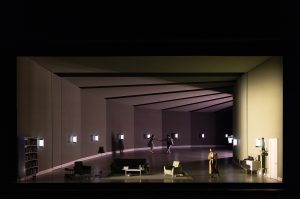
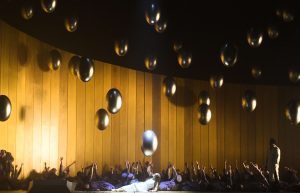
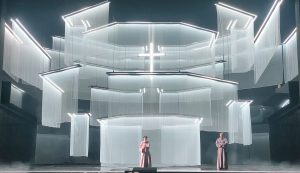
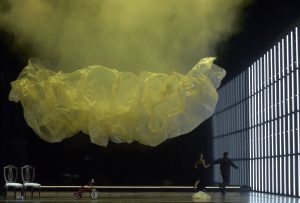
PF: To be honest, I enjoy working on brand-new pieces the most. When it’s a world premiere, the director, singers, and technicians don’t know what the final result should look like beforehand, which completely changes the atmosphere in the room. It’s not like a traditional piece where people say, “Ah, I’ve already seen it done like that.” Everyone pays closer attention when they are building a piece for the very first time. I just did the new opera Il nome della rosa at La Scala, and it was an incredible experience to collaborate directly with the composer. If I have to speak about traditional opera, my favorites that I’ve designed are Don Quichotte in Paris, Macbeth at Teatro La Fenice in Venice, and Wagner’s Lohengrin at Teatro dell’Opera di Roma. I love the historic, realistic pieces less. For me, the more realistic a set is, the more I feel a distance between the work and my world. The more a production is visually suspended, the deeper my connection to it.
LSH: I always think that older operas need to be preserved and passed down like objects in a museum—but we also need to be asking ourselves: what will we pass down from our generation? Which works will define our contemporary era?
PF: Exactly. We have to say something that belongs to our time, otherwise it is not enough. It’s beautiful to mount the classics, but we have a responsibility to speak from our current point of view and create new work that stays—pieces that truly represent who we are right now.
Share a commentWe’d love to hear your thoughts