
 My Melodrama

 Catch while you still can
Katia Ledoux on Memes, Manchester and Mama Morton
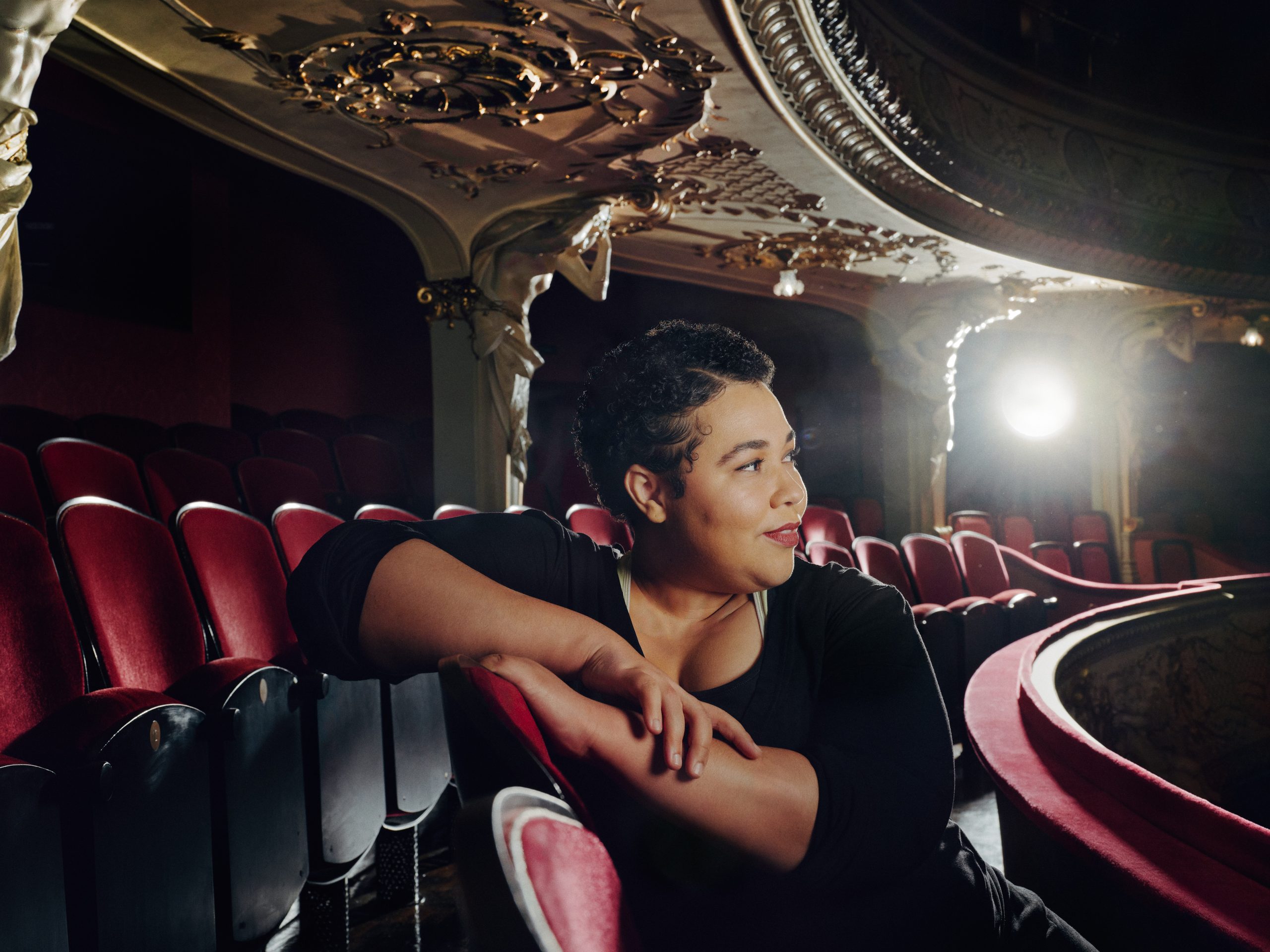
“I didn’t enter the world of opera,” the French mezzo-soprano Katia Ledoux says with a contagious laugh. “The world of opera entered me.” The culprit? A VHS tape of Francesco Rosi’s film Carmen that appeared in her family home when she was three; no one remembers how it got there. Where other children fixate on dolls or dinosaurs, Ledoux fell for singing, and quickly knew the entire opera by heart. She was, by her own cheerful account, not remotely good, and years later, looking for proof of her wonder-child status, she unearthed “terrible” home footage of her many childhood concerts. No one in her family knew the first thing about opera, which luckily meant no one ever told her she couldn’t do it. “There’s always this story people carry, of a moment when someone told them to stop singing, or to sing less, or just to be less,” she says. “I never had that.” That courage got her all the way to the University of Music and Performing Arts in Vienna, until they kicked her out because she couldn’t read music. “They realised quite late,” she says, “because I’m really good at faking it.”
 london

Ledoux was born in Paris and moved to Vienna as a child, but the Vienna she grew up in gave her a hard time. As a teenager and a young singer she met enough racism, and enough people who made her feel that parts of who she was did not belong there, that she resolved to build her career anywhere else. She left, spent much of her eight years away in Switzerland and the Netherlands, assuming she was gone for good. Then, in 2022, she heard that the director Lotte de Beer was to become the first female director of Vienna’s Volksoper, arriving with promises to shake opera awake and examine its repertoire through a feminist lens. Ledoux immediately knew she “wanted to be a part of this vision” and decided to audition. De Beer delivered, and her manifesto is visible to anyone who walks into the theatre: “The ensemble on stage became super diverse in skin colors, origins and
sizes.” For years Ledoux had been told she could never sing Carmen without shedding twenty kilos. Now, thankfully, she sings the role regularly and “People see me as Carmen, because that’s who I am.”
So the city she once disliked now delights her. She tells me with joy how the Viennese dress up, attend, deliberate, argue about a production with friends over coffee a week later, and then sit down with good stationery and write to its star. “I have one right here,” she says, holding up to the camera five (yes, really) handwritten pages praising her latest performance. I genuinely gasp, and then ask whether this form of correspondence is bound to an age group. Ledoux admits her letters tend to come from an older generation, but she’s tickled by how younger audiences are interacting with her and the opera: through memes. “It’s really special to see young people memefying the operas they’ve seen. That’s their way of interacting with it, in the same way older people meet for coffee and talk about what they hated or loved.”
Later this autumn, Ledoux joins the UK premiere of Barkouf in Manchester: Jacques Offenbach’s gleefully absurd satire in which a ruler, exasperated by a province that keeps overthrowing its governors, appoints a dog to rule them instead. It is a concert performance, staged by Opera Rara, the London label and company that acts as opera’s archaeologist, disinterring forgotten works and putting them on stage. “Opera Rara finds these weird pieces that no one performs, that no one recorded, digging through the archives to make sure those histories get told too. If you read the story on a superficial level, it’s really silly. But read it through the lens of a time when it was very difficult to critique the people in power, and it changes.” Offenbach, Ledoux explains, was smuggling his critique past the censors the only way he could. “It was very hard to say out loud that the head of state was terrible. So instead he says: I am talking about a country far far away, that has absolutely nothing to do with this one where the head of state is so bad, that even a dog can make a better job than him.” We detour, briefly, into the venal leaders of our own moment, who could use an operatic skewering of their own. Not all of them, though, Ledoux points out, citing Zohran Mamdani: “It’s possible to get into power and actually use it to help your community, to make the world better,” she says. “That’s such an important message of hope, and of realism. We have an example, right now.”
Now, in an unusual step for an opera singer, Ledoux is tackling the role of Mama Morton in a new production of Chicago, which opens at the Volksoper in October. De Beer heard her at an opera-house karaoke party and asked whether she had ever thought about musicals. Belting out showtunes is, I’m told, the reverse technique of opera: where a singer spends years learning to keep the larynx low and fill a hall unamplified, a microphone lets musical theatre do the opposite. “Now I can belt without hurting myself,” she says. Ledoux has a busy few months ahead; there’s a dog to throne in Manchester, a cell block to run in Vienna and, next year, Puccini to conquer at London’s Royal Ballet and Opera.
Ahead of the concert, Ledoux records the opera in the studio with Opera Rara for its first-ever release, next year.