
 My Melodrama


Last year I saw Fiddler on the Roof at the Barbican and my eyes were opened to a new style of musical storytelling. A type of musical that avoids the high kitsch of pantomime capers but without resorting to the...
 Catch while you still can
Into The Woods



Photo By: Photo by Johan Persson
Ok, we hear you thinking… “A musical in which Cinderella, Little Red Ridinghood, Rapunzel, the Witch AND Jack (with his damn beanstalk) is probably *not* for me.” Except that we are here to tell you that it is. This revival of the late, great Stephen Sondheim’ s masterpiece is a scintillating, gorgeously crafted must-watch. The costumes are completely scrummy too.
image sources
- INTO THE WOODS: Photo by Johan Persson
Run Time
2 hours, 40 minutes
Venue

Dates
From: September 22nd, 2026
Until: January 9th, 2027
Age
12+
What our culture curators are saying


Esmé Thompson
london
rating:

Into the Woods is already one of my favourite musicals, so as a Sondheim fan I came to this show with a certain bias. It’s a truly joyous production, with Tom Scutt’s exquisite costume and set design almost stealing the...
RECENTLY REVIEWED
The Cherry Orchard
London
“In Conor McPherson’s adaptation of Anton Chekhov’s The Cherry Orchard, laughter prevails, as tragedy gives way to comedy with a tendency towards physical comedy. Kristen Scott-Thomas and Ian Rickson reunite, twenty years after The Seagull at the Royal Court, and Rickson and Conor McPherson reunite, almost thirty years after their first collaboration on The Weir, also at the Royal Court, and six years on from their acclaimed adaptation of Chekhov’s Uncle Vanya at the Pinter Theatre in 2020. McPherson’s adaptation draws on Helen Rappaport’s literal translation of the text and, while the performance has moments of tantalising brilliance, there is a sense of imbalance. The question of balance is not new to The Cherry Orchard, when the show premiered in Moscow in 1904 there was a direct conflict between Chekhov’s interpretation of his own play, as a comedy, and the interpretation of the director, the legendary Konstantin Stanislavski, who felt the tragedy of the play. Kristen Scott-Thomas, as Ranevskaya, or “madame”, the lady of an estate that has fallen into a state of financial ruin, returns to her ancestral home from Paris, where she has exhausted her credit, attempted to take her own life, and fled from the reality of her family and life in Russia. Upon her return, she continues her flight, but rather than Paris, it is into reveries and memories that she takes her leave as denial constructs a comforting moat of nostalgia around her. Scott-Thomas is served well by McPherson’s adapted text, and delivers a performance that understands the jeopardy and tension of the tragic and the comic. Though she labours the importance of the estate as her home, a place saturated with memory, beauty, and the vision of God, she evades any responsibility for its salvation, squanders what little she has, and remains intoxicated by a relationship that almost ruined her. Karl Johnson’s Firs navigates the scales of tragedy and comedy with dexterity, and the closing scene, in which he is forgotten and left behind, is devastating in its perfection. The adaptation tried to be too many things for too many people, and thus the harmony of the constituent parts is not quite achieved. McPherson unlocks the comedy of the play, which is dry and tragic, and plays on stereotypes (the matriarch, the amorous maid, the senile butler, the pompous uncle), but the elements of farce sit uncomfortably alongside the tragicomedy of the piece. Overall, it is a play that stands the test of time, with themes that are as relevant today as they were at the turn of the 20th century: reverence for the past; the preoccupation with monetisation; the development of the natural world and gentrification; deforestation; decision paralysis; and, the rise of a new form of landowner.”
Who’s Afraid of Virginia Woolf?
London
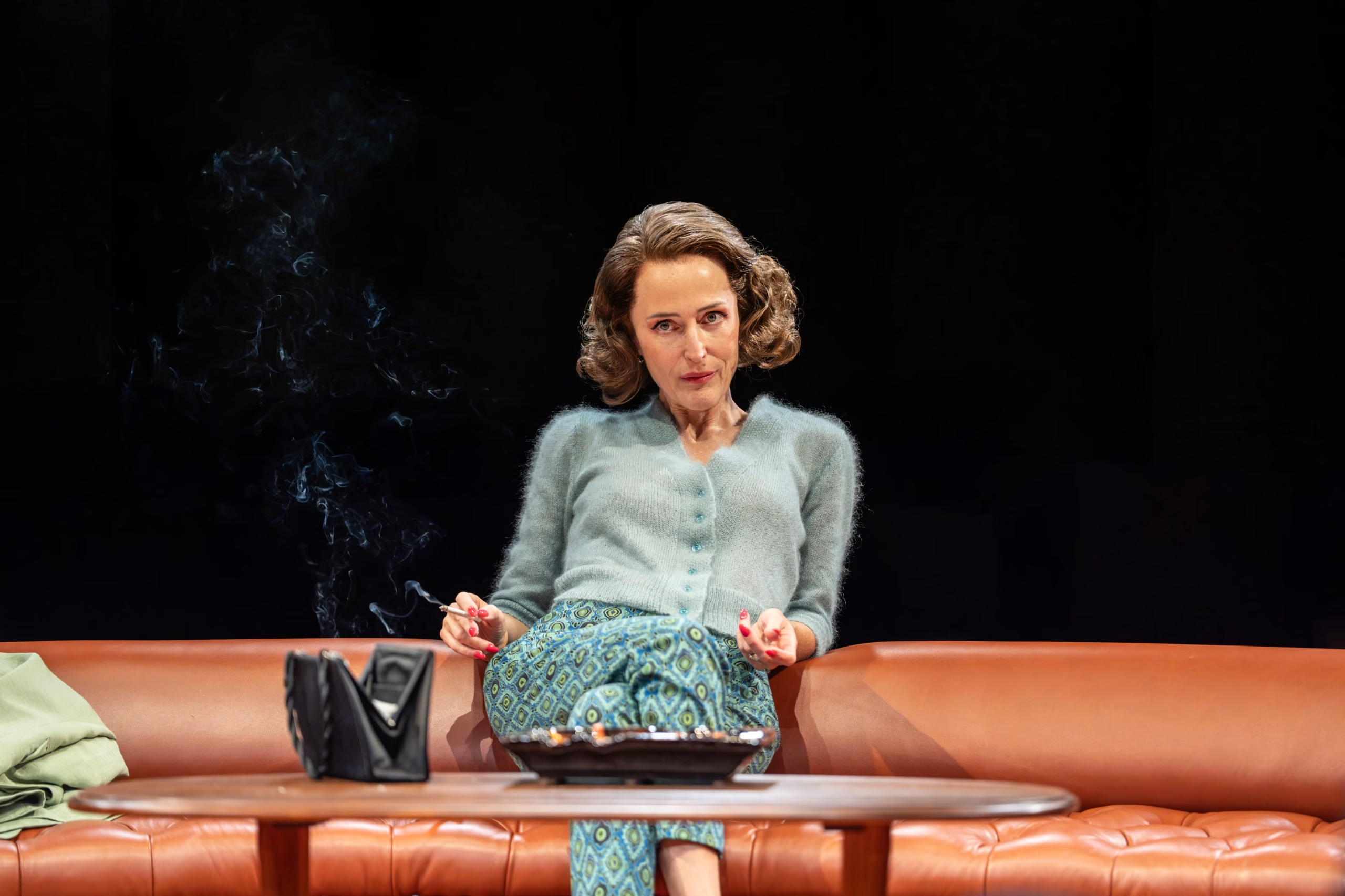
“Bartender, Please Make That a Double. Everyone should see Who’s Afraid of Virginia Woolf? once, but is it better the second time? This question occupied my mind last week and had me in a spin - ‘should I or should I not go?’ On one hand, it really is quite hard on the nerves, but how could I resist such an all-star cast - Gillian Anderson at her finest. Ultimately it felt bad to be rude, so I decided to go, and as we walked to the theatre I merrily joked with my co-curator about straitjackets being carefully stowed under the seat in case of emergency. This production is certainly worthy of the hype. Under the direction of Marianne Elliott, this incredible cast was agile enough to go beyond the script’s machine-gun fire of killer lines to give a superb performance of nuanced sensitivity that gave humanity, coherence, poise and even moments of tenderness to the seriously sick see-saw of George and Martha’s marriage. My one criticism is that the characters did not seem drunk. The energy (and God knows where they get it from) was exhilarating, and if the performance was torture - it was of the most divine kind. My decision to take a whisky in the first interval was inspired “audience participation”, and one which I would fully recommend. The quick change in relationship dynamics and brutalisation of truth, which cut through comforting lies to the heart of the characters’ vulnerability, made compelling theatre, and on Friday the entire cast was superb. This raw exposure of private wounds was reinforced by the slowly turning stage - surely emphasising that there were no hidden corners, when in fact a significant part of the audience response was the collective wish that there could be, just one. About halfway through, I excitedly grabbed my fellow cultural commentator’s notebook and scribbled the words “Francis Bacon”, and we silently nodded in conspiratorial agreement. Was it the colour of the mid-century modern set, the circular stage, the flayed emotional rawness of the script, or the fact that my consciousness is currently farmed out to that particular artist? Or perhaps, because I am an art writer, it was the best way for me to convey what I understood. But it was almost as though Bacon had painted an unlikely heteronormative group portrait in which the conflicting energy was so potent that it unfurled itself off the canvas and played out before our eyes in three and a half hours of measured sickness. Who’s afraid of Virginia Woolf? Not me - I am ready for the drink-along matinee!”
Share a commentWe’d love to hear your thoughts