
 My Melodrama

 Catch while you still can
Downtown Theater’s Scott Shepherd on the Wild, Hilarious, and Lyrical beauty of James Joyce
Actor and practitioner Scott Shepherd has an “extreme‑sport attitude toward performance.” A beacon of The Wooster Group and Elevator Repair Service—experimental theatre ensembles known for their radical, form‑bending work—he has worked with everyone from Leonardo DiCaprio to Elizabeth LeCompte.
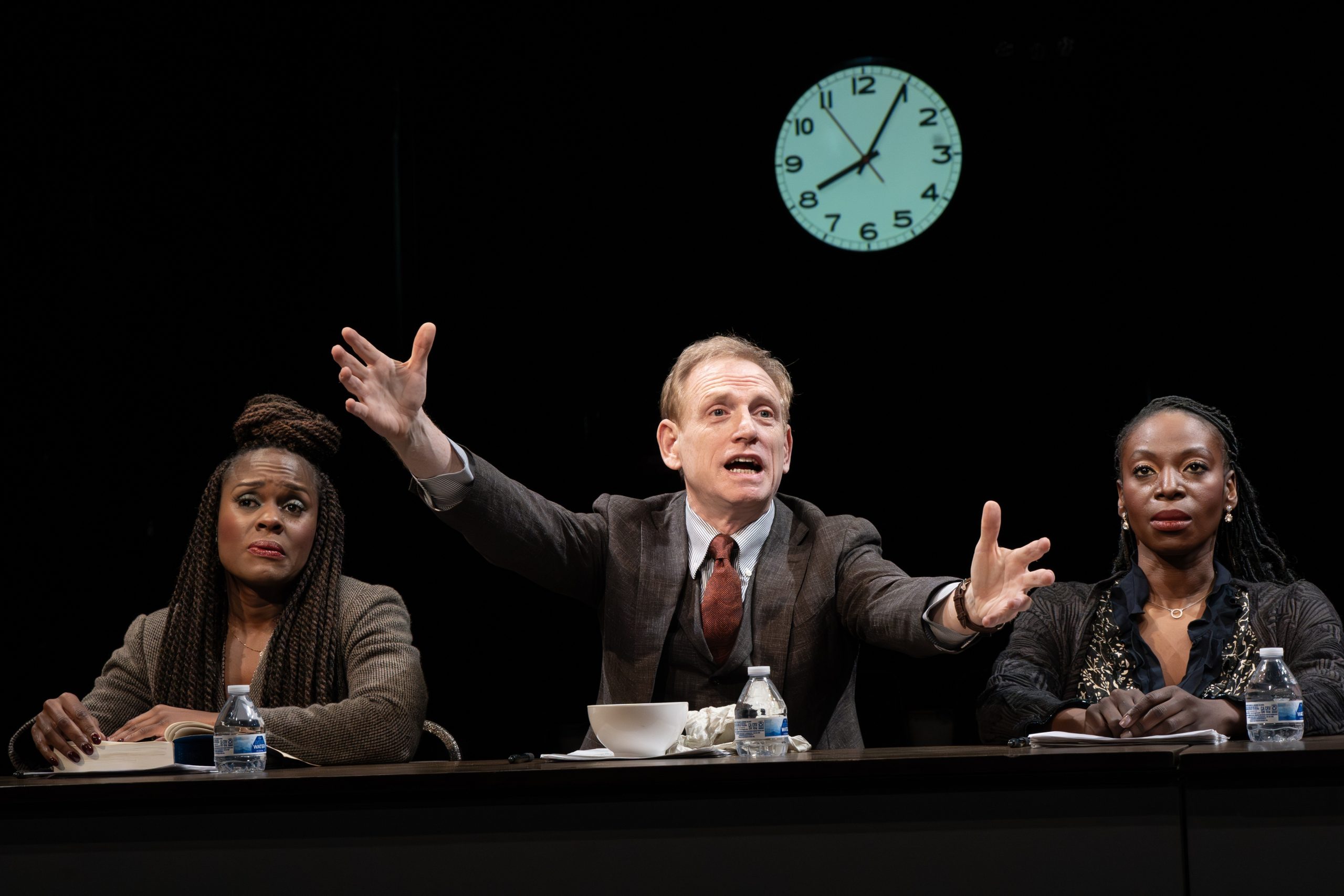
Still, he says he feels most at home on stage experimenting with heavyweight texts: “That’s what I understand; that’s what I grew up in.” He’s currently tearing through James Joyce’s Ulysses at the Public Theater: “Once you get past the wall…the book’s reputation for difficulty—you find it’s wild, hilarious, full of delights, and of lyrical beauty.”
Scott chats with Alex Jhamb Burns on a blisteringly freezing New York City day about surviving 6 hour marathon stagings of The Great Gatsby, how many times he’s read Ulysses (“I just go swimming in it every once in a while.”), and how his character in Killers of the Flower Moon has a villain‑fandom wiki page.
Ulysses is on at the Public Theater in New York through March 1st.
 new york

Alex Jhamb Burns: Hi Scott. Nice to meet you!
Scott Shepherd: Hey, how are you doing?
AJB: I’m doing okay. How are you?
SS: I’m good.
AJB: Well, congratulations on Ulysses. I went and saw it this past Saturday at the matinee, and I really enjoyed it. I must confess that I have never read Ulysses.
SS: We’re very interested in the whole gamut of readership of Ulysses. I’m happy if somebody says, “I taught a Ulysses seminar for 10 years and I really loved the show.” I was like, yes, we pleased one of those people. I also love it when somebody says, “I really want to read the book now.”
AJB: So I guess I’m curious: what was your introduction to the text? When did you first read it?
SS: In college. It was kind of a slapstick comedy. I signed up for a class called Critical Theory. The idea was you signed up in the spring, read Ulysses over the summer, and then the class was in the fall. But it wasn’t actually a class about Ulysses; it was about critical theory, and you would go through the history of approaches to literature and apply them to Ulysses. I had a desk job at AT&T with a lot of downtime, so I’d open my drawer and read a little more Ulysses and hit skids in passages where I really didn’t know what was going on or what the significance was, but it was okay because it was all going to get explained when I returned to college. Before I got there, a letter came from the professor saying he’d used Ulysses for years and was ready for a change, so we were going to do Through the Looking-Glass instead. It was a two-edged sword: I had motivation to force-march through Ulysses, but I didn’t get the explanation I expected.
At some point after college, maybe in my twenties, I had a second wind for literature. Reading great works when you’re not in school, with a little life under your belt, they feel richer in meaning. Ulysses got back on my list. This time I used aids: someone told me the best way to read Ulysses is out loud, and I also had an audiobook to listen to. Listening gives you more tolerance for not understanding but continuing until things come back into focus. That time I had a much better feeling of having a handle on it. Fifteen years later or more, John—
AJB: That’s director John Collins, right?
SS: Right. John got an invite from Symphony Space to do a Bloomsday event for the hundredth anniversary of the book’s publication, and I dove back in for what you’d call the third time. At this point, my experience with Ulysses is—I can’t tell you how many times I’ve read it. I just go swimming in it every once in a while.
AJB: Just for our readers: Bloomsday is the annual celebration held on June 16th to commemorate Ulysses, which takes place in Dublin on that day in 1904. Was this for the 2022 version?
SS: Well the book was published in 1922…
AJB: Haha! Go ahead.
SS: A crazy thing happened: John was asked to be a guest director at Theater Basel in Switzerland, to direct a production with their actors speaking German. When he spoke to them, they asked what he was working on with his company; he said Ulysses, so they said bring it to us. He thought we’d develop the piece and take it to Germany. Because of COVID we had not worked on it much with our company—maybe a couple of rehearsals—so we arrived in Germany and had to figure it out there with unfamiliar performers speaking the text in German translation. It’s been a crazy ride.
AJB: As both a performer and co-director, were you responsible for determining which parts of the 18 episodes were included or omitted?
SS: Absolutely. That was my first assignment: what are we going to pick out of this? It seemed daunting, if not impossible. Ulysses feels singularly uncondensable and unsummarizable; it has a mission of radical inclusion of every aspect of life, bodily function, language, style. As soon as you start taking selections, you risk losing the whole idea. John and I considered picking one page to represent the whole novel and quickly decided against it because Joyce writes each chapter in a completely different style. We wanted to serve up some of that smorgasbord.
I remembered a movie trailer—from the early 2000s for Brian De Palma’s Femme Fatale—where the trailer was the entire movie played in fast forward with occasional slowdowns. I thought maybe we could do that with Ulysses. Our reputation largely comes from our production of The Great Gatsby, where we read every word in a six-and-a-half-hour performance, but we weren’t going to do that with Ulysses; it would take about 26 hours. I picked a page from each chapter that stuck with me, that stood alone and represented the chapter. I had 18 pages when we arrived in Basel, and we quickly discovered that wasn’t enough. On stage, you want to know who the people are, their relationships, and what you’re supposed to follow.
AJB: You mentioned your marathon production of Gatsby—where you performed the exact text all the way through. In what ways was working on Ulysses different from that?
SS: Gatsby was where the conviction was born for our company: a commitment to the original writing of the author, not to convert it into a play but to afford the audience an opportunity to encounter the text the author wrote. Can theater be like reading a book, with the book in charge of the theatrical event instead of just providing story or characters? That commitment guided us with Ulysses. When selecting, we tried to pick chunks we didn’t have to edit internally so we wouldn’t be fiddling with the written text, rhythms, or sentence-to-sentence choices. We wanted to deliver the writing and let it teach us.
AJB: Last one on this: you’ve spent so many years with this text, and people like me who haven’t read it will see the show. What’s your pitch for why read Ulysses or see this show?
SS: Once you get past the wall—the book’s reputation for difficulty—you find it’s wild, hilarious, full of delights, and of lyrical beauty. Our show tries to give a peek behind that imposing wall at the delights inside. The show ends up being wild because we’re trying to keep up with Joyce’s wildness.
AJB: Cleaning the stage must be fun afterwards.
SS: Yeah. It gets covered. There’s a mess early on and in a later scene the mess gets cleaned up, but in Ulysses—
AJB: I thought when we returned from intermission we’d be at a clean slate, but I liked that we weren’t. It just piles on. We don’t get a little break, but I think that’s fine.
SS: Maybe that’s an indication about the two writers: Fitzgerald’s impulse is to tie off strings and make it all mean something, and Joyce doesn’t quite do that. He lets it dissipate into a totality of everything that is not summarizable or condensable; you can’t turn it into a sentence.
AJB: Another notable role you’ve had was as Hamlet in the Wooster Group’s 2007 spin on it. In Jason Zinoman’s New York Times review he called you a “practitioner of extreme acting”. Would you identify with that?
SS: I like that. I’m into the idea of an extreme-sport attitude toward performance. Gatsby was a marathon performance where I was center and did most of the talking. With Hamlet, we were in one of those Elizabeth LeCompte machines—LeCompte sometimes overwhelms the performer with many tasks. We had in-ear pieces where we were plugged into Richard Burton’s Hamlet and the video was projected behind us but sometimes erased so it was a ghost haunting the show. We could see the unerased version on monitors and had to keep up with it. Even camera-angle changes required quickly moving furniture on wheels into new positions. That was a little like extreme sports as well.
AJB: Do you think you’ll ever play Hamlet again?
SS: Every once in a while LeCompte talks about it and I would love to. It always feels like a privilege to say those words.
AJB: Looking back on your theater career, do you have a favorite production you’ve been in?
SS: I loved doing Hamlet, but I’d have to say Gatsby. At the end of Gatsby, the theater is full of people who’ve been there all day; they’re proud of themselves and excited to hear the ending. I’ve been reading from the book the whole time, then I close the book and it’s just me with them for the final chapter; Fitzgerald knocks it out of the park finishing it. That feeling of expectation, shared experience, and the writer’s performance to close that book—being the person who delivers that—I don’t think I’ll ever have an experience like that again. It’s amazing.
AJB: You’ve been in many films in addition to theater. If you had to pick one, would you only do theater or only do film?
SS: Theater. That’s what I understand; that’s what I grew up in. I feel all right on stage—I know how to read it and how a room feels; the audience tells you so much. You do the story from beginning to end and live through it. In film, you’re making little pieces put together later; it’s fragmentary, you shoot out of order, and it takes more mental effort for me to put it all together. To forget that jigsaw-puzzle work in front of the camera and just be is tricky. I love the challenge and I’m still learning. I feel like an apprentice of film acting and I’m still learning how it works.
AJB: About Killers of the Flower Moon—you have a villain fandom wiki page for Myron Burkhart. What was it like to play such a clear villain (and to play Leo’s brother!)?
SS: I didn’t know about the fan page; we’ll have to look for it. That film was a thrill to work on and challenged my imposter syndrome. My first day I was in a room with Robert De Niro, Martin Scorsese, and Leonardo DiCaprio. I was in a scene listening to them talk and then came forward to say one line. I learned a lot on that film. As for playing a villain, you have to find a way to be on the side of the character you’re playing no matter how despicable their actions. It’s doubly challenging when it’s a real person and real murders happened and you’re trying to be responsible to all of it. We talked to a relative; Leo and I drove out to the house of someone who had grown up in a house with them, one of the few people still around.
AJB: Like grown up in a house with Byron Burkhart?
SS: With both Byron yeah, and Leo’s character, Ernest.
SS: I remember feeling a strange responsibility to her and to get it right, or at least close. There will inevitably be distortion because of what you don’t know and because you’re a different person than who you’re portraying. After talking with her it weighed on me, and it was gratifying to get a note from her after she saw the movie saying we really captured him. So I guess I did. Portraying a character involves responsibility to show that side of humanity. That’s why we’re interested in it—to understand what makes people do those kinds of things.
ONE MINUTE WITH MELODRAMA
FAVORITE PERFORMING ARTS VENUE?
SS: The Performing Garage, home of the Wooster Group, and where the first underground performances of Gatz played in a blizzard in January 2005.
PRE-OR-POST SHOW/REHEARSAL HAUNT?
SS: Toad Hall on Grand St. RIP Lucky Strike, formerly next door.
IF YOU COULD SEE JUST ONE SHOW FROM THE PAST?
SS: Erin Markey and Emily Davis in The Singlet.
STRANGEST AUDIENCE INTERACTION?
SS: There’s a part of Ulysses where soft fake bread props go flying and some land in the audience. One night during the curtain call a mini croissant arced out of center house and nailed the top of my head while I was bowing. I never found out who threw it, friend or foe, but either way you’ve got to admire the aim.
A LINE YOU’VE CARRIED AROUND IN YOUR HEAD AND CAN’T GET RID OF?
SS: These have coming up lately:
Hamlet: Virtue cannot so inoculate our old stock but we shall relish of it.
Gatsby: Reserving judgements is a matter of infinite hope.
Ulysses: Force, hatred, history, all that. That’s not life for men and women. And everybody knows it’s the very opposite of that that is really life.
Leave A ResponseWe’d love to hear your thoughts on this show!
You must be logged in to post a comment.