
 My Melodrama

 Catch while you still can
The Divas Are Coming Off the Walls
On the first floor of a former Victorian silversmith’s atelier on Fleet Street, on the opening night of Frieze week, Ashley Saville Gallery is packed to the picture rails, and a figure is reading a monologue from beneath a papier-mâché box camera. This is Physiologic Pasta II, an “absurdist opera” by multi-disciplinary Eve Jefferies, staged for one night alongside an exhibition of monoprints and sculptures by the artist Tess Tomassini. The pairing was Tomassini’s doing. Seeing a kinship between their work, she invited Jefferies to stage the piece inside her show. Performance among the prints!

 london

A recent ArtForum article lamented the rise of plays being mounted by visual artists for largely art-world-y audiences, questioning their “uneven regard toward audience and dramaturgy.” I would fall elsewhere on this matter. Let’s face it, the theatre has always suffered a bit of an image issue (either too high-brow or frequently too low-brow) and the art world simply carries more cachet. So if the curators and gallerists are embracing performance and play, I’m not going to be the one to complain about it. Let’s not be too heavy-handed: it’s an entertaining way of coaxing the art off of the white walls, giving the imagination somewhere to go. As well as offering us a break from the uniformity of groups dressed in black, sipping some obscure sparkling wine from whichever brand the gallery has managed to wrangle as a sponsor, and muttering sweet nothings about paintings they’re barely registering. Can’t we have it all? Silly and spectacular experimentation in art spaces and hard-hitting theatre elsewhere? Melodrama’s Clementine Melvin was at the gallery on Monday night and rang me immediately afterwards. As she told me, there is something to be said for how precious people think gallery spaces are, and having actors in flamboyant costumes with face paint certainly goes a long way towards breaking down these pieties.
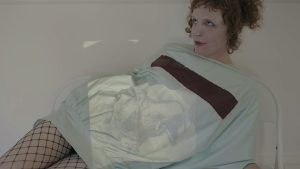
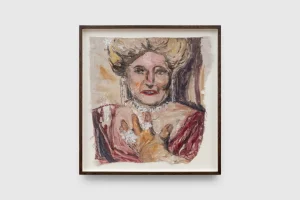
The two artists at the center of this curation are circling similar themes: the self as something you construct. Tomassini’s exhibition takes its title from the last line of a Frank O’Hara poem—the air becoming no air becoming air again—and her subjects (drag queens) are in the act of getting ready. Beside them hangs a large diptych of the actress Anna Nicole Smith, who modelled her platinum-blonde bombshell persona on Marilyn Monroe. “We constantly try to copy what came before us, but we’re never able to really copy it, because in our mimicry we divert,” Tomassini says. “We go somewhere else. And I think that’s what’s so beautiful about it.” The sculptures across the rooms make the same case in three dimension: found objects she collects on walks, bones, wings, scraps of Catholic iconography (from her half Italian household), old toys, reassembled into what she calls her mutants. “I’m Sid from Toy Story,” she explains laughingly. Her prints and sculptures both, in her words, are about “iconography and relic,” copies of copies that always end up as something other than they began.
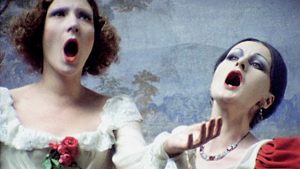
Jefferies trained in fine art at Goldsmiths and now works across any and every medium she deems intriguing; writing and composing (she wrote a new song in response to the title of the exhibition) as eagerly as she makes artworks or designs the (fabulous) programme for this event. The body and the image have preoccupied her for years, but this particular work began with a viewing of the German filmmaker Werner Schroeter’s The Death of Maria Malibran, a 1972 fever dream of lip-synced arias and dying sopranos. It led her to the divas, and the masochism of their art, and eventually to a passage from an old documentary about Maria Callas, who lost nearly forty kilos in 1953 after a summer encounter with the gamine Audrey Hepburn (or so the legend goes). A Roman pasta company, Pantanella, claimed credit for the transformation, advertising that Callas had slimmed on their “physiologic pasta”; she sued, and the show takes its name from this ridiculous episode. The documentary narrator relays the damage with grotesque relish: “the skin hung off her like an empty bag, and it remained around her ankles.” So, Maria the woman “became Callas the artist,” Jefferies says, “and in doing that she had to shrink herself.” There is something fascinating about hearing an artist trace what first sets an obsession going, and here it loops straight back to Tomassini’s interest in how things transform.
Tomassini, for her part, has had performance running alongside her practice for years. She does not perform herself (although she admits under questioning to being a keen dancer), but she has become an impresario along the way, staging For One Night Only to a sold-out room at Bethnal Green Working Men’s Club and producing the shadow-puppet troupe PLPC. She has come to suspect her prints and sculptures are performances too, just unseen ones. “You only get to see the ghost,” she says. “The aftermath of it.” A show taken with documenting the moment of becoming asks, in the end, to see the process in action. For one evening at Ashley Saville it did, and each artist made the other richer.