
 My Melodrama

 Catch while you still can
THE SEX APPEAL OF THERMODYNAMICS
I saw Arcadia twice at the Old Vic earlier this year. Long have I admired Stoppard, indeed, when Melodrama asked me who my favourite playwright was I responded – Stoppard – two months later he died, Indian Ink (1995) opened at the Hampstead Theatre, and Arcadia (1993) followed at The Old Vic. A fitting tribute to a polymath and playwright of dazzling lucidity.
image sources
- Arcadia: Manuel Harlan
 london

I had been told before going that Arcadia was undoubtedly a masterpiece, but that I might find it impenetrable, the science and mathematics beyond my comprehension, and the resulting two-hour fifty-minute running time something of a cognitive overload. I would like to dispel these sentiments. On my second viewing I was sat next to a lovely woman, Tabitha, who, upon learning I had already seen the performance, asked if she “needed to be clever” to understand the play. She was spellbound, as I had been. One friend told me that she felt that it had “permanently altered [her] brain chemistry”. I feel quite the same.
The drama unfolds within the same room of a stately home in Derbyshire across two timelines. In the historic timeline, we are witness to the mathematics lessons of Thomasina Coverly, a teenage prodigy, from her tutor, Septimus Hodge, a recent Cambridge graduate and friend of Lord Byron. In the contemporary timeline, Valentine Coverly applies chaos theory to grouse populations on his estate. Meanwhile Hannah Jarvis, an academic researching the garden’s transformation from Enlightenment order to Romantic chaos, locks horns with Bernard Nightingale, an egotistical professor researching Byron. The narrative weaves and intersects itself, revelations from the first timeline reveal misperceptions in the contemporary timeline. As a viewer, we see what happened, and we simultaneously watch as the contemporary characters attempt to decipher the past. Like a thousand-piece puzzle, each line or phrase, perhaps indistinguishable in isolation, constructs a glorious image, with a conclusion that is momentous, tragic, and inconceivably satisfying.
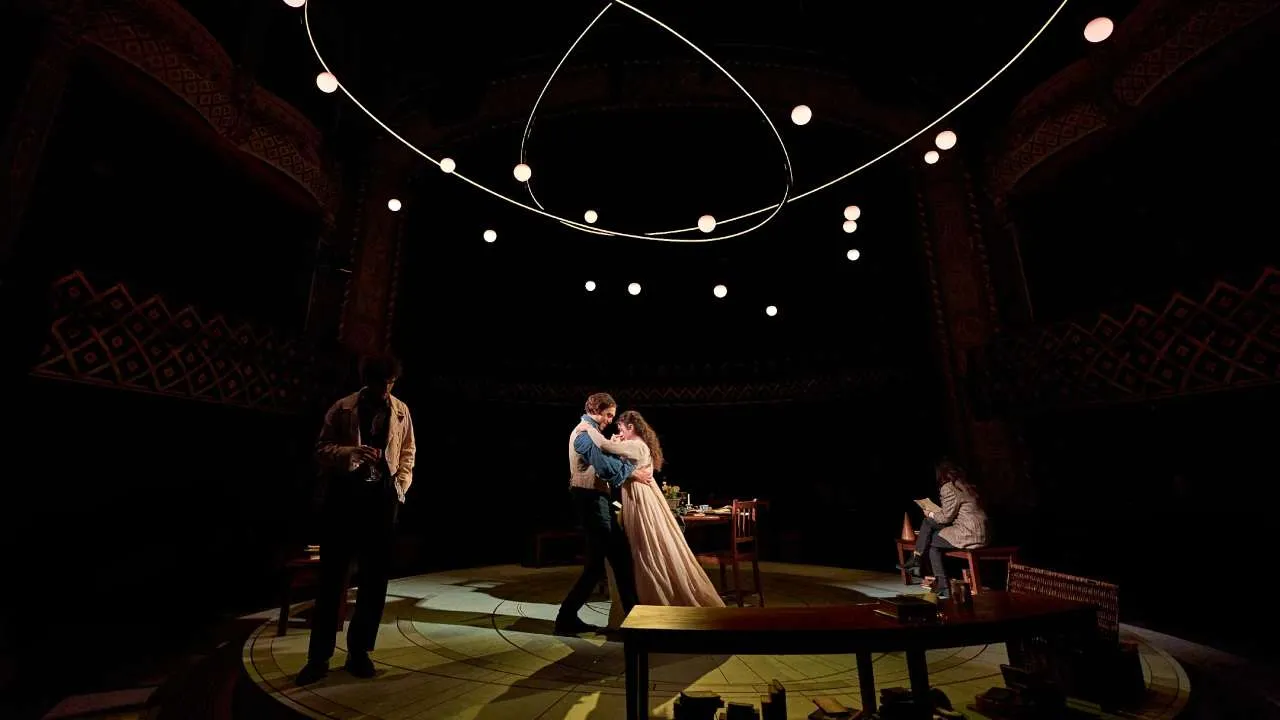
Performed in the round, on a revolve, the lines of the stage floor moving in opposing directions mimicking the rotation of ancient puzzle maps that might reveal some hidden astrological pathway. Above the stage, a mobile of lights that resembled a solar system rose, fell, and slowly rotated with the tempo of the performance. The staging felt understated, elegant, and utterly absorbing, evoking the cosmic magic of the theories aired within the text.
The show is worth seeing for the chemistry between Isis Hainsworth and Seamus Dillane alone, they were remarkable – utterly compelling, coy, and charismatic, carrying the play off the page. Their performance was rich with yearning, because Arcadia is also a deeply romantic play – Stoppard succeeded in making mathematics and thermodynamics sexy.
I plan to see the play again, and I would recommend anyone who asks me to do the same. What awaits is a show that handles complicated topics with dexterity, dynamism, and joy. Entropy is manifestly sexy, the flow of heat from one body into another, and enlightenment rigour clashes with self-indulgent romanticism across past and present. If, like me, you feel compelled to see a further iteration of the show, a recording of the 1995 performance at the Theatre Royal Haymarket is available to be viewed in the V&A archives.
Share a commentWe’d love to hear your thoughts
You must be logged in to post a comment.