
 My Melodrama

 Catch while you still can
600 Performances On, a Brazilian Play About Homophobia and Humanity Reaches London
It is winter in Rio de Janeiro, which is to say it is 29 degrees. Armando Babaioff appears on my screen laughing about the two days this year he has needed a jacket. His Brazilian production of Michel Marc Bouchard’s play Tom at the Farm opens in London at the Barbican in October, so I offer that there will be a need for more jackets.
image sources
- : Murdo MacLeod
 london

Tom at the Farm, which some may know from Xavier Dolan’s 2013 French film, follows a young man who travels to a remote farm for his lover’s funeral, only to find a family who never knew their son was gay, and an older brother prepared to enforce that ignorance with escalating violence. Babaioff first read it in 2014 and halted at a sentence in the preface: “Homosexuals learn to lie before they learn to love.” He felt compelled to acquire the rights, translate the play into Portuguese himself, and assemble a creative team under director Rodrigo Portella. He is careful, though, not to let the play be reduced. For him the play is not just about homophobia; it is about patriarchy, and about what silence does to humanity. I sense an urgency behind his words as he explains all this. He uses the word “mission” several times, at one point telling me that he has put all his money into the play and its continued production. “I can’t do this work like a job,” he says. “It’s not a job, it’s my life.” There is nothing performative in how he says this.
Throughout our conversation, Babaioff impresses on me his belief that the theatre is “the last frontier, the museum of humanity.” In Brazil, where he is a household name along with his co-star Denise Del Vecchio, the production has absorbed a decade of Brazilian politics from the stage. “When I started, we had the first woman president of Brazil [Dilma Rousseff]. She suffered an impeachment; I was on stage. Another guy occupied her place [Michel Temer]; I was on stage. Our country split by polarisation [under Jair Bolsonaro]; I was on stage. The pandemic came; I was on stage.” He finds no comfort in the play’s durability: “It’s hard for me to understand that the problem is not resolved,” he says. Brazil remains the deadliest country in the world to be queer, recording more violent deaths of LGBTQ+ people than anywhere else. And for the first time in almost a decade, the number of countries criminalising same-sex relationships rose rather than fell in 2025.
What he wants from his audiences is not sympathy but recognition. In Edinburgh, a man from Alabama told him after a show that he had left a farm and his family, for exactly the reasons on stage. Babaioff collects these stories in every city the company visits and in doing so has stopped trying to direct where the play lands. “Don’t put an arrow, don’t put a target. Just do” he tells himself now. The Guardian has called the production “the death of hope”, and the phrase still sits badly with him. When I ask, tentatively, whether it is a hopeful play, he deflects the question, shaking his head. “Hope does not live in a play. Hope lives in the audience.”
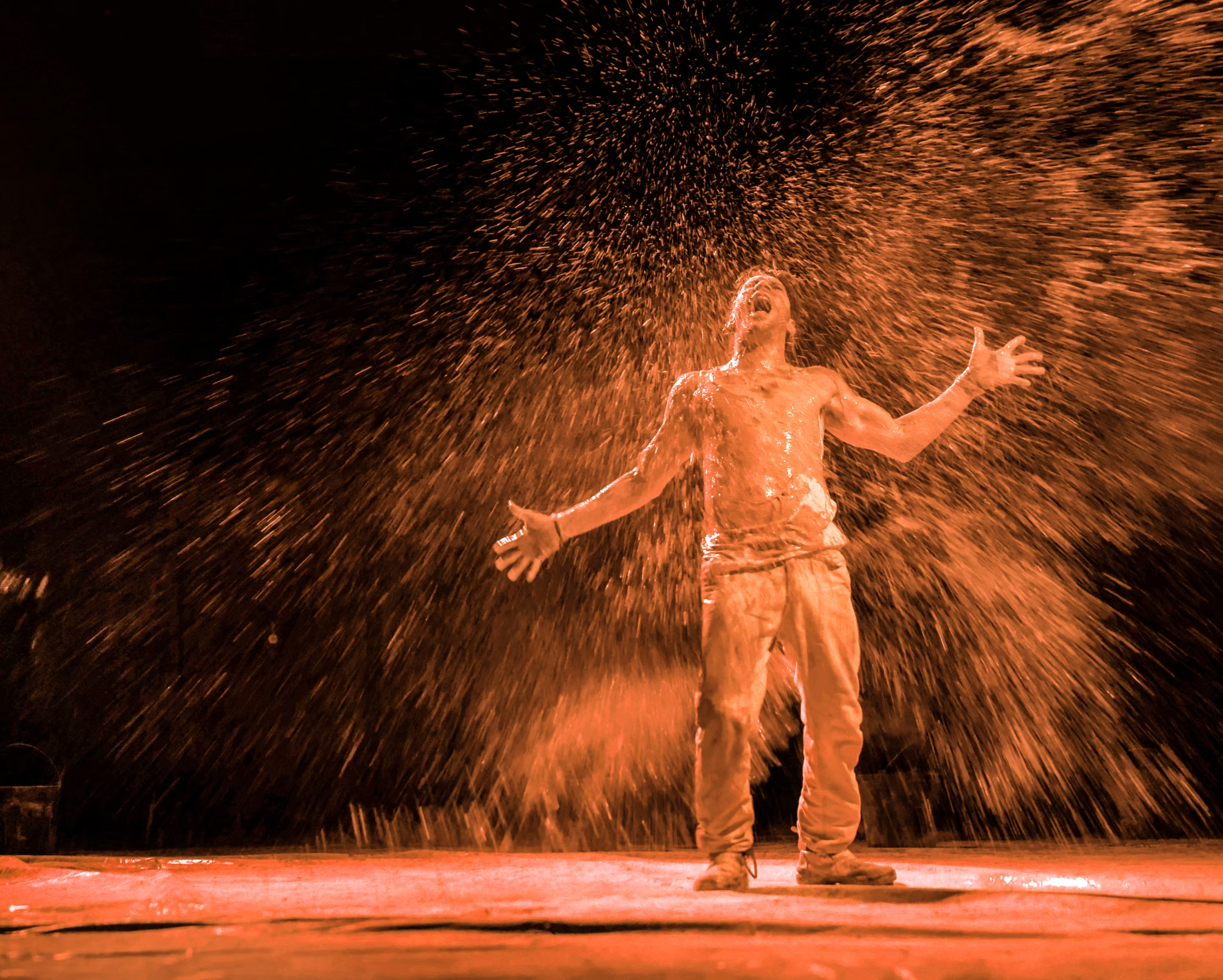
There is no denying that the play is a phenomenon. It has run 17 seasons in Babaioff’s hometown of Rio alone, played to 7,000 people in Edinburgh at the Fringe Festival last summer and performed a month in Paris where, he estimates, only one per cent of the audience was Brazilian. It has toured Switzerland, France and Belgium for months, invited, as he understands it, as “the artistic answer of the theatres for the growing of the far right in Europe”. When we speak, they have just performed in a 125-year-old opera house in the middle of the Amazon. So, after what amounts to over 600 performances, the obvious question is how it stays alive across a decade. He reaches for a metaphor, unexpectedly, in football. “It’s about the athlete’s faith that repetition is not sameness but training. To do the play every time, for me it’s a kind of exercise.” The metaphor makes more sense in light of the punishing physicality of the work; the set is a sheet of plastic filled with mud, and over two hours Babaioff’s Tom — who arrives suited and urbane — is dragged into it until the mud has claimed him entirely. In the early years he broke two fingers and a foot on stage, hit his head on the floor and nearly took out both knees. He has trained to minimise the danger since.
Looking towards the London premiere of this work, his greatest wish is that Sir Ian McKellen, whom he describes as a lighthouse, might attend. And then there is his dream to be the first Brazilian play performed in Portuguese in the West End. For now, there is the Barbican, whose raw concrete feels like a building the play might have grown out of. He promises British audiences something brutal; death or life. “I want to make people confused,” he says, leaning forward. “I like to see people’s brains shaking.”
Share a commentWe’d love to hear your thoughts