
 My Melodrama

 Catch while you still can
WHITNEY WHITE’S THEATRICAL PILGRIMAGE
Theatre polymath and artistic force Whitney White spent the last month on a sort of pilgrimage to the “Holy Land” of theater makers. Otherwise known as Stratford-upon-Avon, the town where the Bard was born and is (almost certainly) buried. White’s residency took place at The Other Place, the Royal Shakespeare Company’s experimental studio that famously housed Ian McKellen and Judi Dench’s iconic 1976 Macbeth.
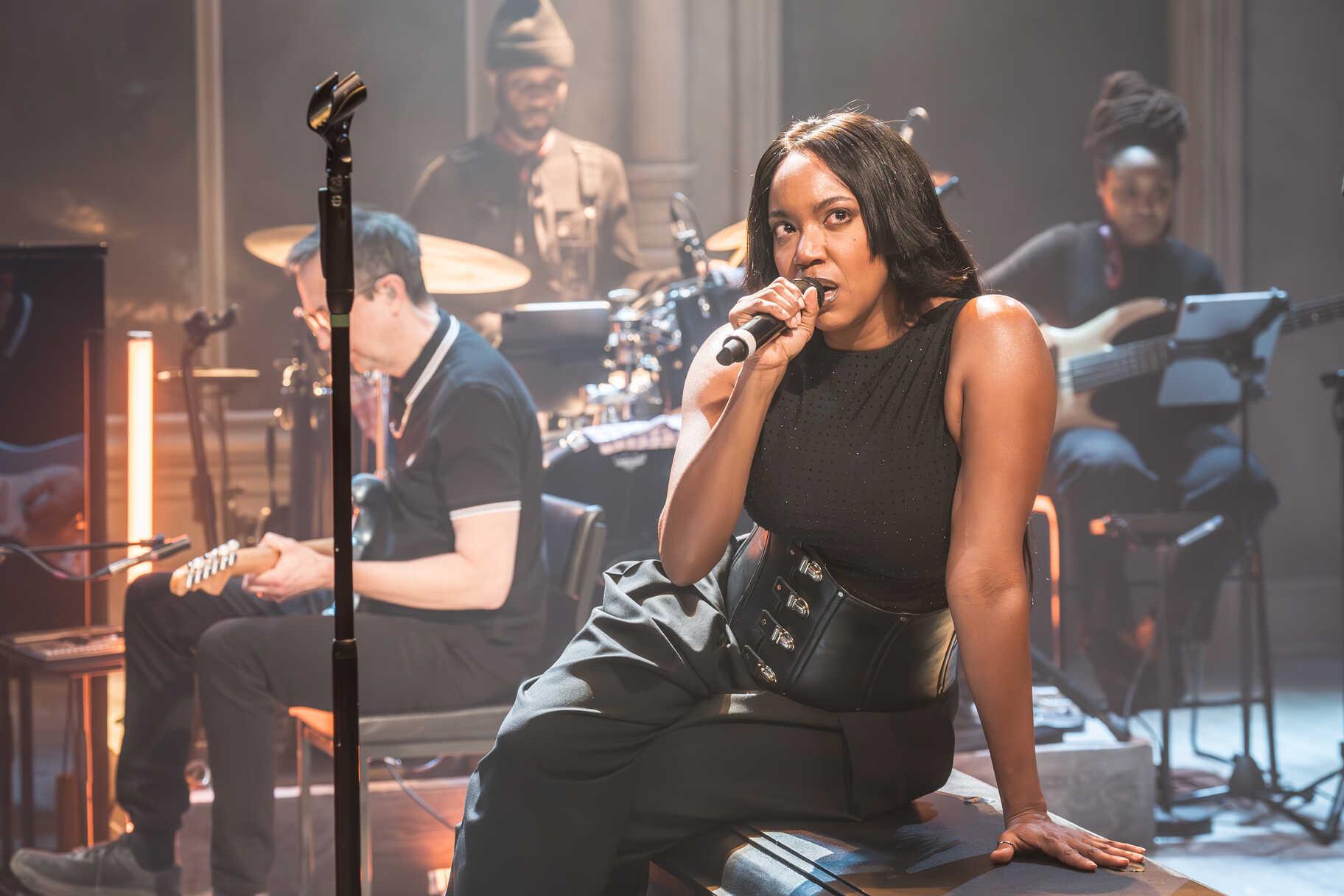
The New York-based, Tony-nominated director/performer wrote, composed, and starred in All Is But Fantasy, a raucous, concert-style production that places four of Shakespeare’s characters—Lady Macbeth, Othello’s Emilia, Juliet, and a gender-swapped Richard III—centre stage. These are the women who usually don’t live to see the curtain call and are brought to life here through a collision of (tweaked) text and an epic score ranging from gospel to rock and roll.
On the day before closing night, White sat down with Melodrama to talk about the “miracle” of a live audience and why music makes “all art better.”
Catch White’s next show The Whoopi Monologues, a reimagining of Goldberg’s iconic Broadway play, at Lincoln Center’s Off Broadway stage this summer.
 london

Louise Snouck Hurgronje: So great to meet you Whitney.
Whitney White: Nice to meet you. Thank you for talking.
LSH: Truly the honor is all mine. I feel musical theater was my gateway into theaterland and I’ve been dying to talk to you because you infuse many of your shows with music and exuberance. Were you a musical kid growing up?
WW: Yes, I always loved music. Music was definitely my gateway into art making. I grew up listening to Portuguese and French singers, reggae music from Jamaica, all kinds of things. I started singing very early and met an incredible voice teacher, Susan Payne. That’s when I discovered how much I love to sing. From there everything opened up: opera, rock, jazz. I love music. It brings me peace. It makes all art better. Why not?
LSH: I feel like music can evoke such a visceral reaction in people. Do you notice that with your audiences?
WW: I think so. Music is a part of everything. When you read Shakespeare’s text, a lot of times there are songs in there. Twelfth Night’s Feste has a song. It’s normal in many cultural artistic practices for music to accompany storytelling.
LSH: So, I guess you’re in Stratford for one more day?
WW: Two days. We have one performance tonight of Juliet and Richard III and tomorrow we’ll do all four and we’ll have a closing. I’ll be very sad, but it has been such a fantastic collaboration here with the Royal Shakespeare Company.
LSH: Yeah, how has it been for you to be in the Holy Land?
WW: As an artist, it’s been fantastic because you grow up reading these plays and sonnets. To come here and go to Trinity Church, where Shakespeare was both baptized and is allegedly buried, that’s very meaningful. It’s like a little bit of a pilgrimage for a theater maker.
LSH: So you are a self-proclaimed Shakespeare nerd. Were you always interested in re-reinterpreting these 400-year-old texts for the stage?
WW: It happened late for me because I did start out as a musical theater performer. Then I went to a graduate acting program at Brown University. In order to learn vocal pedagogy, you learn something called a 50-line speech from a Shakespearean text. If you can master that, then you’re really coming into your vocal facilities. Those early exercises are what opened up a whole new world for me. I found the whole scholarship surrounding the practice of doing classical texts to be deeply fulfilling. It ignited my creativity and imagination, and has never gone away. I’m a strong proponent of arts programs and arts education and what it can do for people, because you never know what’s going to unlock your mind.
LSH: Shakespeare is such a behemoth, a beast to be conquered in many people’s minds. A lot of people can feel like, “this isn’t for me” or “what have I got to discover here?” Do you have people telling you that you’ve convinced them give these texts a go?
WW: I experience both. I experience women and people from all kinds of socioeconomic backgrounds who say, “Thank you for helping me see myself in this work.” And I’ve also gotten letters from Shakespeare purists who say, “I’ll never think about these texts the same way.” The work is just making space that’s already there. When he says all the world’s a stage, that’s an honest statement. The plays are about everyone. Modern people started dictating who can and can’t be in the plays, but I don’t think that’s actually in the play texts. Everybody is in there.
LSH: I read that Cirque du Soleil was one of your formative experiences…
WW: Oh yeah. My mother took me to see Quidam in the 90s and early 2000s which was next level. The players, the acrobats, the music. It was like total theater in this way. It really blew me away. I was quite young and I watched the whole show just mouth open, eyes wide in pure disbelief, you know. It was this cinematic all-encompassing visual journey and I was “Wow, I want to do that. I don’t know how. I don’t think I’m going to be an acrobat, but I think I want to do something like that.”
LSH: Speaking of total theater. Do you think you’d like to make an opera?
WW: The opera world still feels extremely closed off to female directors, especially female directors of color. There’s a couple of wonderful women working in there. Lileana Blain-Cruz did an incredible piece at the Met. It’s a dream. I got very close on something recently, but we’ll see, it’s a very closed circle. For me everything is storytelling and making a movie is one form of storytelling. Making a musical is another. Making a play is another. Making a play with music is another. There’s different technical needs and background training that you need to be very good in these different areas, but essentially we are all doing the same job in some ways. Once you start looking at it like that, the hierarchy of it all just kind of breaks down in your mind. You know, a storyteller is a storyteller.
LSH: I read something you said which I wanted to ask you about. That you want your college friends to be able to love your shows, and people from home to feel like the theater is also a place for them. Is that something you’re consciously thinking of?
WW: I just try and make the best work I can for as many people. We won’t survive if we’re only telling stories for one small group. Everyone should be invited in, much like a church.
LSH: Yeah. Church for me was also a way into theater. I wanted to be a priest because for me that was a kind of performance. Once I realised I could seek that out in the theater…
WW: I agree with that. There’s a lot of great writing on that—is the theater the new church you know? Worship is dwindling across the Western world… So I guess we’ll see if that trend continues.
LSH: What was the most magical thing about your last few weeks in Stratford?
WW: Two things. The first time we read and sang through the texts—that was like watching fire ignite for the first time. And every single night we perform, when the audience gets on their feet, that’s incredibly meaningful. You are nothing without your audience. This is not a solo sport. I think every night that the audience is here with us is kind of a miracle, honestly.
Louise Snouck Hurgronje: A miracle in what way?
Whitney White: Oh, that like the story is landing in a group of people. It’s only real if it happens between performers and an audience. Every night when the lights come back up and you realize that you’ve been sharing space and time with wonderful strangers for two to four hours, that’s the miracle of it. That we all have made a contract to be together in the same place and time to see the same story. That’s a very special thing in today’s fractured world.
Louise Snouck Hurgronje: That’s beautifully put. That is ultimately what we’re selling, right? An experience with a bunch of strangers in a dark room! You can come out the other end transformed. I saw that Soutra Gilmour did the set design for All Is But Fantasy. Who are other artistic collaborators recently that you hold dear?
WW: I worked with Tony Gale on sound design and Ryan Day on lighting here. Simona Budd, my music supervisor, was fantastic. All of the UK-based artists I just worked with—I definitely won’t forget it.
LSH: Working with these incredible people must be so fulfilling! Where else are you looking to for your inspiration?
WW: Well the work of Marina Abramović and her longtime collaboration with Ulay, her former partner, has been very inspiring. I could spend hours, months watching footage of her older performances of them together. She’s a seminal artist, one of the greatest to ever work and live. A lot of her work inspired this piece because so much of it was durational work. You know her thing she did in New York where she sat for hours and would look everyone in the eyes? I also looked at the work of Adam Curtis, he’s a filmmaker who my husband introduced me to, which I’m really grateful for because he’s doing these serial films that sometimes are like four or five hours and really add up to something profound. And then in terms of scholarship, I look to Emma Smith, who’s a brilliant female Shakespeare scholar, one of the best in the world, Stephen Greenblatt and Gretchen Gerzina who wrote Black England. So I try to split my time finding sources across film, performance art, music, and literature.
LSH: I must read Black England! So where can we find you next?
WW: I’ll be going home to my family. Then in June, I’ll go into rehearsals for The Whoopi Monologues with Lincoln Center Theater in New York City.
LSH: Have you worked at Lincoln Center before?
WW: It’ll be my first time!
LSH: Exciting! Well, I’d better let you go. It was a delight to talk to you. Wishing you all the best for closing night tomorrow.
WW: Thank you so much. Speak soon.
Leave A ResponseWe’d love to hear your thoughts on this show!
You must be logged in to post a comment.