
 My Melodrama

 Catch while you still can
FROM COLLAGE TO CREATURES: DESIGNER ANJA VANG KRAGH’S JEWEL BOX
From years spent working for John Galliano during his Christian Dior reign, to the hallowed stages of the Royal Opera House and the Royal Danish Ballet, Danish designer Anja Vang Kragh occupies a space where fashion and theatricality collide. She is a master of modernist maximalism, using beautiful historical techniques to “clone, twist or merge” them into something entirely contradictory.
In this conversation with Louise Snouck Hurgronje, the creative super-force discusses Galliano’s “anarchistic rawness,” the “long afterlife” of a glorious ink-stained costume for the 2014 production of Don Giovanni, and why, in a world obsessed with newness, the most beautiful act can often be “daring to stay still.”
 london

Louise Snouck Hurgronje: What ignited your love of design and costume? Was this born early on in life?
Anja Vang Kragh: I was born into a creative family, my father an architect and my mother an artist painter, so drawing and thinking abstractly was always a natural part of my earliest memories. They always encouraged me to use my imagination, to find my own ways. My mother was a sharp dresser and I loved watching her dress up in her feminine avant-garde style. To experience how clothes, textures and colour tones could transform a person. My closest childhood friend and I were always playing dress-up, making up all sorts of weird and wonderful characters. So everything was very playful and all about storytelling.
LSH: What drew me to your costumes, other than their utterly fantastical beauty, is the way that you present them through collage and sketches. I am obsessed with these creations. Can you tell me a little about this process?
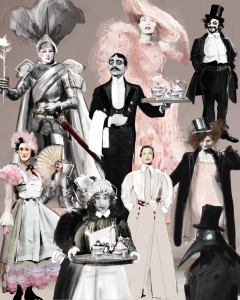
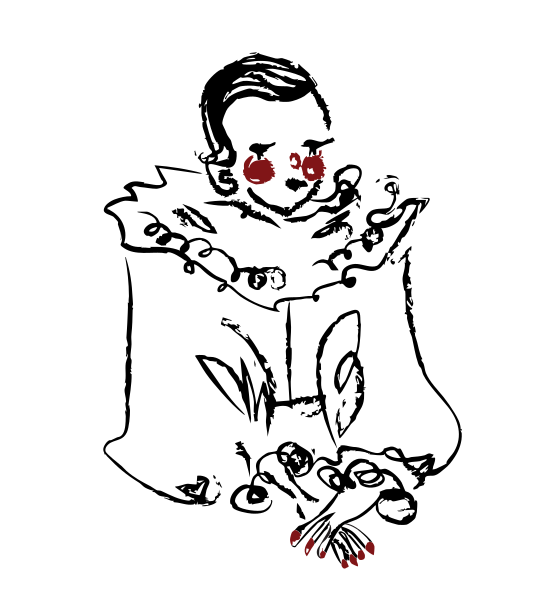
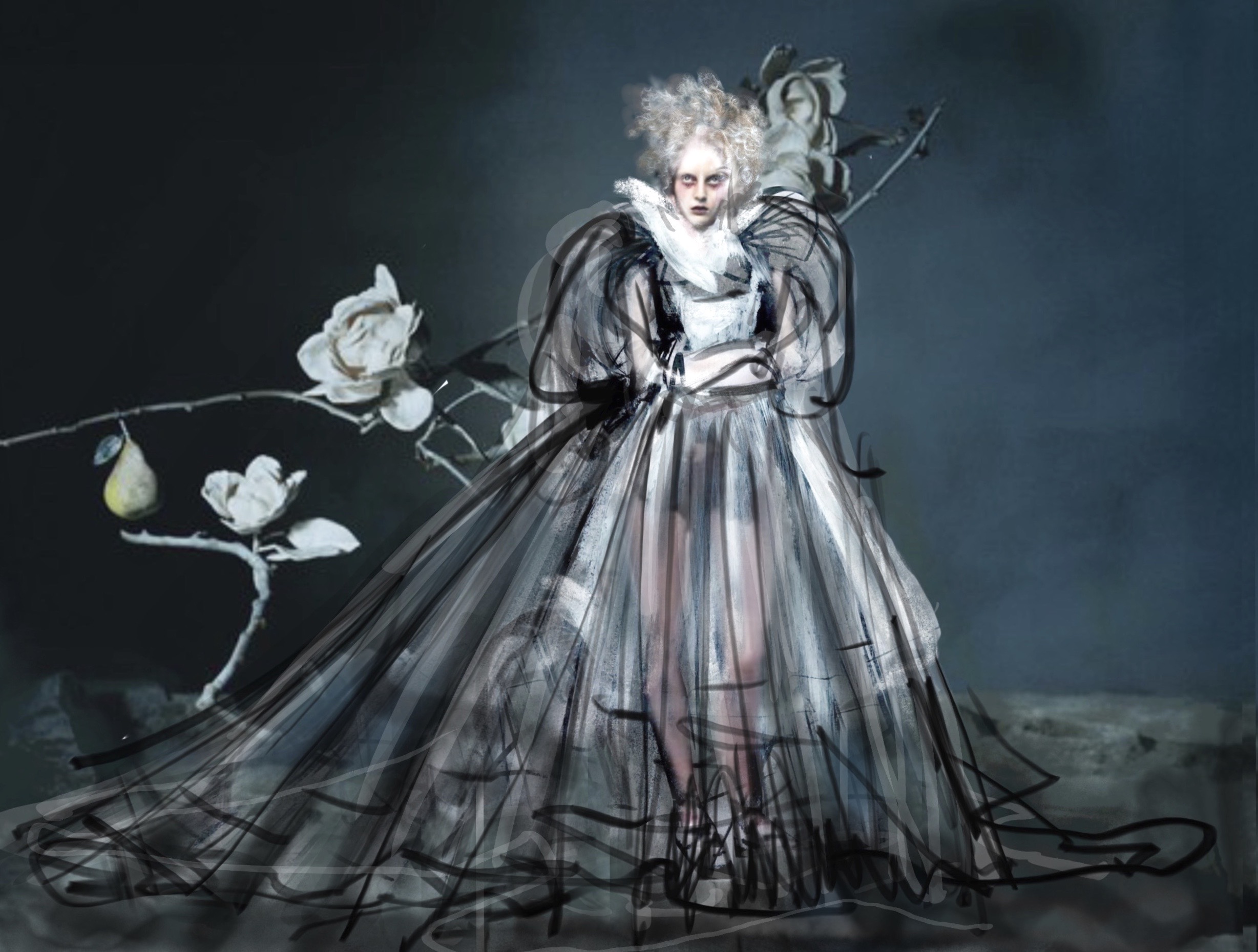
AVK: This is just how I create my costume sketches! Even though I was quite strong in drawing in my fashion school years, I somehow was just very drawn to the sharpness and surreal touch of collage styles such as the old Soviet photomontages from the 1920s and 30s. German collage artist Hannah Höch was also a big inspiration. So collage became my way of expressing myself. When working for John (Galliano), he really encouraged me to explore this artistic expression further. I did these large-scale 3D collages for him instead of drawings. When doing costume sketches now, I still use collage style to some extent in combination with hand sketching.
LSH: Yes indeed, you worked for Galliano in Paris for many years during his Christian Dior reign. I mean, few designers have shaped the fashion industry or a house as dramatically as he did. His creations for Dior were rooted in storytelling and are undeniably theatrical, is this perhaps where fashion met costume for you?
AVK: Definitely! In my fashion student years at the design school in Copenhagen, Denmark, I somehow never really could see myself in pure, cold fashion, but from the moment I saw John Galliano’s fantastical work I knew that he was my hero and I absolutely had to work for him. It was such a relief to find out that fashion could be fun and theatrical. That a fashion show was like creating a whole world full of complex, amazing characters. However, the most important thing was that the cuts and drapings of the creations looked so new, fresh and sharp that nothing looked like old dusty theatre. It was high sculptural art.
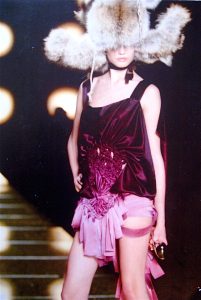
Dior Fall 2002. “It was the old macrame technique done
in a bolder scale in degrader coloured silk satin.”
LSH: How were these years working with him?
AVK: I absolutely loved it! John was just like I had imagined him to be: a creative super-force. His ability to always push a look and idea further was pure joy to work within. He loved to always go into unknown territory and was always open for exploring the qualities of even the smallest and silliest ideas. My work was to make new drapes, shapes and techniques for the garments, plus creating large life-size collages for magazines. He gave me full freedom to just do what I loved the most.
LSH: Is there a collection or design you worked on during your time there which had a distinct impact on your creative psyche?
AVK: I thought the Dior couture Spring/Summer 2000 was glorious. It was one of the very first collections I worked on and John had pushed my ability to create deconstructed silhouettes to the max! I was blown away by experiencing how much visual noise and anarchistic rawness he could merge into this high luxury brand without losing its sophistication.
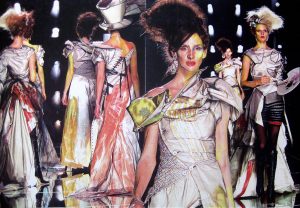
The John Galliano Spring/Summer pret-a-porter 2003 is another good one. Inspired by India; the finale looks of the shows were totally abstract and contemporary uni-colored silhouettes. Big and bold silhouettes splashed in colourful pigments that flew around in the air when these larger-than-life silhouettes moved around on the runway.
LSH: Your work seems to perfectly toe the line of fantasy and reality, which is a rare and almost impossible feat! Is this something you are aware of?
AVK: Yes, it is. I think it somehow has to do with the fact that I am aiming to find a fine balance of something old and recognisable but done in a new, fresh way. I love to use beautiful historical techniques and forms and then clone, twist or merge it with something very contradictory. I love when clothes and costumes become interesting and fresh in that way. And then I guess I just really love to make a character beautiful and elegant. Even if I am making a costume for a dusty beggar or a dark, evil creature for example, I aim to make them look strong and glorious in all their misery.
LSH: So when you moved from fashion to the performing arts, what did you have to learn and how did your designing change?
AVK: It was both very similar, because Galliano is very much of the performing arts, and very, very different. First of all, I had to learn that it was no longer possible to get the atelier to make 2-3 toiles (mock-ups in toile fabric) before cutting the garment in the real fabric. That was really difficult to me because the toile stage was where I really worked with a shape and developed a silhouette. Now suddenly all ideas had to be precise in a little 2D costume sketch. And even more terrifying; the costume workshop just cut straight into the real fabric in the first go! It took me some time to find a constructive way to work my way around that.
Another thing that I also had to learn the hard way, because I am a maximalist at heart and love to create complex abstract creatures, was that in performing arts sometimes less is more because there’s a story to tell. There is a character, someone that the audience has to feel for and relate to and who plays a part in a bigger story. So it can be very conflicting and distracting if you sit with a giant flower headpiece on while talking about marital problems for example. A costume’s utmost job is to emphasise a character and mood.
In fashion I could work with my “creatures” like a raw canvas. As a free artwork. A good costume is also an artwork I think, but the journey to the final look is much more complex. That is also what makes performing arts so interesting and always fresh and new. It is gesamtkunst superieur!
LSH: You also have a textile and production studio, how does this side of your artistic experimentation inform you?
AVK: Yes, in 2019 I created Vang Stensgaard together with my longtime best friend and work partner, Mia Stensgaard, who is an extraordinary set designer. We had both worked (independently and together) on big productions in the performing arts for many years and had a craving need to create something for just the two of us. A little con-amore project, where we could take the time to just experiment free from deadlines and budgets. Our love for textures and storytelling could just flow freely without limits.
LSH: Did you create those otherworldly fabrics for the backdrops of La Sylphide at The Royal Danish Ballet in 2020?
AVK: Yes, for La Sylphide the entire set design consisted of our textile designs; the entire stage was filled with fabric drapes. We created fabrics that were loaded with fairy creatures, both dark and somber, and light and poetic. La Sylphide is all about these contradictions, and the dream of stepping out of the rational world and into a magical otherworld. To follow one’s dreams really.
LSH: I imagine your home to be filled with many wonderful fabrics?
AVK: Yes, I love to use fabrics in my home! To see the colour tones on the fabrics and walls shift throughout the day and night. Plus it’s a perfect way to hide all things ugly.
LSH: What do you love the most about working on opera or ballet productions?
AVK: I love how changeable it is. A new production, a new story to tell. It demands me to open new hidden doors in my creative inner space. Another fabulous thing is how wonderful it is to work with new teams and artists every time. The performers are really like the finest thoroughbred racehorses who master their art perfectly. It is exhilarating to watch and to collaborate with them.
LSH: And how do you think these genres should progress?
AVK: I really love early baroque operas, the older the better. I don’t really need it to be modernized so much. To me, opera and ballet are perfect to keep just as they are: a rare and exotic specimen that needs protection and fertilization with the best conditions in order to unfold and flourish. It’s like a peep into a magic box from another time and place, and I think our modern lives need this contrast to really understand ourselves, our culture and the background to where we are now. To me, progression is often to dare staying still.
LSH: A fascinating take in a time when Opera houses are so desperately seeking to innovate. You live in Copenhagen, where do you seek inspiration in your city?
AVK: I love the Glyptoteket which has a beautiful collection of both old and new art, and a fabulous palm tree garden.
LSH: And more broadly, where do you seek and find inspiration for your work?
AVK: Nature will always be my main inspiration. The colours, the textures and the lavish and ingenious constructions. It can be flickering shadow play on a wall, or a bleak winter day when all colour tones have transformed into a cornucopia of greys and whites, or the way a bird transforms into an extravagant firework display when courting. I am also very much inspired by shapes and constructions, so just walking the streets and looking at buildings and houses can inspire with interesting meetings of materials and colours. However, as a costume designer, I am first and foremost inspired by the story that has to be told in the specific production I’m working on. It is the story that tells me where to go and where to start seeking. It is like setting off on a great explorative journey without a precise destination. Curiosity and openness is key to finding new ways. Everything can be inspiring. Even a bus ticket can open up to a fairytale.
LSH: What did that journey look like for Griselda at The Royal Danish Opera for example? These designs took my breath away!
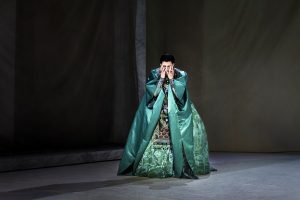
AVK: Griselda was a real treat to create. It’s a small little gem with just six characters and no chorus. When I was hired, the job description said that the costumes should constitute a large, important part of the scenography. Each character had only one costume, and that costume should contain many layers. I was very inspired by old traditional Japanese theatre costumes because of their voluminous and expressive powers, and by Asian traditional clothes in general because of the way they consist of many layers and are not cut close to the body. However, I didn’t want the costumes to be specifically Asian, but rather a rare mixture of all times and places. Griselda is a strange story from a long time ago and its themes are so difficult to relate to in our modern time. In short, it is about a king that drags his beloved wife through many horrible and inhuman trials to test her love for him. Therefore our director, Beatrice Lachaussée, wanted to set it as a fairytale from a non-specific place. It could be everywhere.
LSH: It’s an impossible question, but if you had to choose a favourite design that you’ve made?
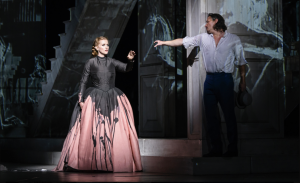
AVK: It is indeed impossible to choose one costume as my favourite! I have a good selection of costumes that I feel did more than just their job on stage, both for the artist performer and the story. An example could be Donna Anna’s dress in the Don Giovanni production that I did for the Royal Opera House in London back in 2014, directed by Kasper Holten. That opera has had a long afterlife and is still being performed all over the world. So I have experienced how Donna Anna’s dress always makes the artist who wears it look ravishing and feel powerful. It is a dress that is both simple and wild at the same time, because of its black ink dripping down onto the dusty rose-coloured bodice and skirt.
LSH: And lastly… can you mention some of the most meaningful and memorable collaborations across your career?
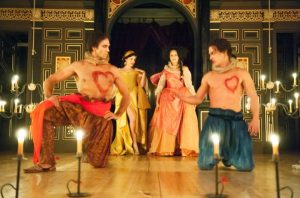
AVK: Also an almost impossible question to answer as they nearly all are meaningful, but of course my years working for and with the magical master wizard John Galliano will always be a glorious experience that I forever will keep in my heart and inspiration tool-box. In the performing arts, a small baroque opera production, L’Ormindo, that I did at the Sam Wanamaker Playhouse in London in 2014 is also very dear to me. The Sam Wanamaker Playhouse is a replica of a theatre from the 1500s, so the stage is tiny and all light is created with candlelight. It was so magical and meaningful.
Share a commentWe’d love to hear your thoughts