
 My Melodrama

 Catch while you still can
JOCELYN BIOH’S COMEDY TRAVELS (WELL) FROM HARLEM TO HAMMERSMITH.
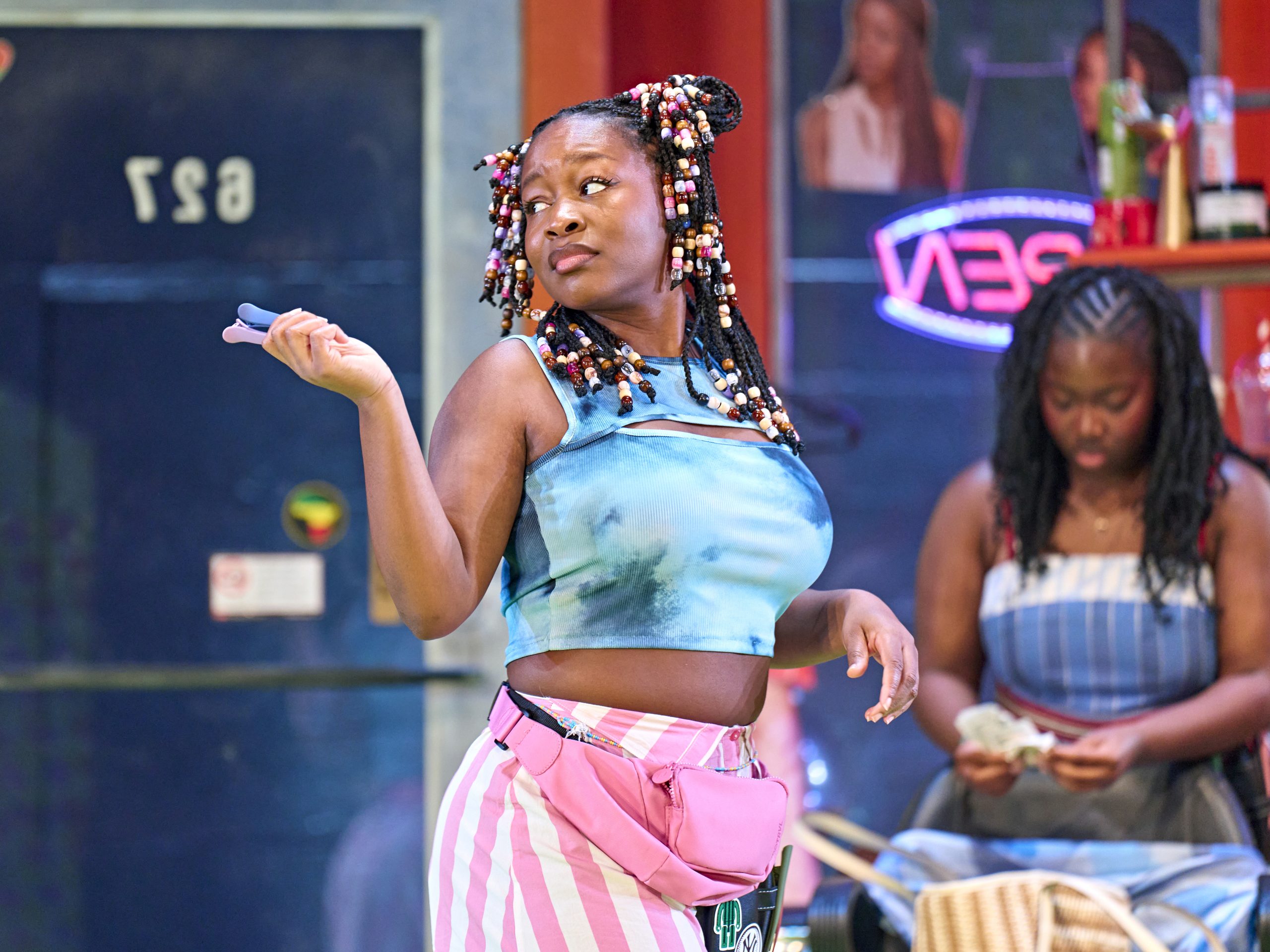
At the London premiere of Jaja’s African Hair Braiding last week at the Lyric Hammersmith, the air was alight with shrieks and uninhibited, riotous laughter—the sounds of an audience recognizing themselves in the action on stage and absolutely loving it. At the center of it all is Jocelyn Bioh, the New York-based Ghanaian-American playwright who crafted this vibrant, belly-laugh-inducing story set during a single day in a Harlem braiding salon. “That’s what makes so many of my characters and my stories funny—they’re rooted in truth,” Bioh says. “Audiences recognize that truth and gravitate towards it.”
Fresh off the adrenaline of the London opening, Bioh sat down with Louise Snouck to discuss her work exploring characters within the Black and African diaspora. They talk through the 18 rewrites required to get the script right (the fewest she’s ever done for a play!), her childhood spent studying sitcoms, and why she is “just obsessed with people, their lives, the decisions they make, and how those change the course of their journey.”
Jaja’s African Hair Braiding runs at the Lyric Hammersmith until April 25th.
 london

Louise Snouck: Oh my god, I had the best night last night. I honestly have very rarely had an experience like that at the theater. Just like the palpable joy and the shrieks in the room! The girl next to me, I think she came alone as well and I always love to see fellow solo theatergoers, she was genuinely talking back at times.
Jocelyn Bioh: People get so excited. It’s very fun. And honestly it’s not like what you experienced is some rare night. This is what it has been every single night of previews. I’ve been really very moved to see audiences like that in the theater in terms of like even the demographic, the makeup and the energy. I think that’s really rare universally in theater, but I’m getting the sense at least from the cast and some of the people who live here who say that that’s a rare experience.
LSH: In New York, it’s different. People engage with theater differently. But actually, it’s so much more fun this way. London audiences can be stuffy sometimes, and this felt collaborative in a way that was unique.
JB: It’s been amazing. This is a wonderful way to kind of send me off back to my crazy country.
LSH: You’ve worked with the Lyric [Hammersmith] before with your play School Girls [School Girls; Or, The African Mean Girls Play], right?
JB: Yes. In 2023. But not even close to this involvement because when School Girls was on I was very pregnant and incredibly close to my due date. So, I actually never saw School Girls live here! This has been a different experience, I’ve been in London for two months for the entire rehearsal process, involved in everything from the set design discussions, costume, hair, all of it. That has felt really rewarding to really be a part of building the thing.
LSH: Is that how you like to work preferably?
JB: I do. I’m a very ‘involved producorial oriented playwright’ is what I’ve heard many many times and I think it’s because I really care about what I write. I would say that I really beat myself up in terms of writing really great plays. JaJa’s [Jaja’s African Hair Braiding] I rewrote 18 times and that is the least amount of rewrites I’ve ever done on a play in my life. I consider it a great privilege to be a playwright and more so be a working playwright. It is a real honor to be able to put so many different versions of black people on stage. If I get the opportunity and the privilege to do that, then I’m going to do my best to do it right.
LSH: I’ve read that your gateway into this world was as an actress. Your characters are so incredibly vibrant and multi-faceted. When you’re writing, are you also feeling what it would be like to bring these characters to life because of your background?
JB: Thank you. I appreciate that. I like to write plays for really brave actors who are unafraid of jumping into roles that are sometimes gritty, sometimes not always noble, who are very truthful. That’s what makes so many of my characters and my stories funny is because they’re really rooted in truth. Audiences recognize that truth and that’s why they tend to gravitate towards the characters. I like writing character-driven narratives. A perfect weekend for me would be watching a documentary about anyone back to back. I really am just obsessed with people, their lives, the decisions that they make and how that tends to change the course of their journey. I try to put a lot of that into my work. Is that influenced by my work as an actor? Probably. I think I’m writing roles that I would have always wanted to play, but I don’t know that I’m actively thinking of that when I’m writing. I think I’m just trying to really be in service of the character and the truth of what their arcs and their way of being are.
LSH: And what do the cast of JaJa’s now, but also in previous productions, tell you that it feels to be in a production which is rare—to be an all black production and to be playing these amazing roles?
JB: Because it’s a comedy, I think it’s deceptively hard. The experience of it feels so fun. You read the play and you’re like, “Wow, what a fun play.” And then you have to put that thing on its feet. Because of the technicality of the words, even just the speed of sound of what a braiding shop sounds like—there’s no dead air, ever. Everyone’s always talking over each other. There’s braids being done, people coming in and out. There’s a real skill and technique to all of that. I think the actors would say now they’re having more fun, but when we were in the rehearsal process, they were really understanding like, “Whoa, this is hard.”
LSH: You’re within the confines of a small braiding shop over the course of a day and it is grounded in the dialogue, the banter, the community and their relationships. Can you tell me about the sitcom-esque of it all?
JB: This is the first play I think I’ve ever written that takes place over the course of one day. That in and of itself is a challenge because for the most part we all have pretty standard days. We wake up, we go to work, we run errands. But some days end up being more extraordinary than others. You think your day is going to be one way and then you get a phone call or somebody delivers a piece of news and all of a sudden everything about your entire future has a question mark on it. I wanted to really highlight what an extraordinary day looks like for this group of women. There’s a weird interesting structure for a play that is truncated into one space, one day. Sitcoms obviously have done that very well. In 25 minutes, you have a problem presented, comedy in between as they try to solve it, and then in the end the problem is either solved or it isn’t. I think my play is doing that. I’m not solving the problem because I absolutely don’t have the answer. But I am presenting the audience with a question about what they can do in their own world to influence what the answer is. I don’t deem to be able to solve large world problems, but we all have a small part in being able to solve it in some way.
LSH: Do you look at your plays as posing different questions for your audience?
JB: I do. Because I’m exploring characters within the black and African diaspora, there are a lot of questions. There are a lot of experiences that we have that are systemic and feel like they’re out of our control. But if other people who are not part of our community can understand what our experiences are, they can help be a part of the solution. If I’m going to invite people into our worlds and our experiences, then I have to highlight what those experiences and those problems are. I delve into that with School Girls. I have no solution for people’s implicit bias about colorism. But I can present how that makes someone like me feel and hope that will shift the minds of audiences as they move through their own lives. That’s the best I can do as an artist.
LSH: I also think that’s the beauty of the theater, that you can have this audience come together from different demographics and experience the same play and take different things away from it. If you haven’t sat in a braiding salon before, you’re not going to have those shrieks of recognition, but that doesn’t mean that you’re taking away anything less. Was the theater part of your life growing up?
JB: No. And I grew up in New York City, so that feels wild to say. I grew up in Manhattan, too, where Broadway is. I was only a couple train stops away. But our family couldn’t afford it. Theater was just not part of my two Ghanaian immigrant parents’ zeitgeist. Like many other immigrants, they came to the country, started a family, and wanted their kids to be successful and be in pursuit of that American dream. The first time I ever went to see a show was because somebody gave tickets to the community center. I saw my first Broadway show then which was Jelly’s Last Jam starring Tanya Pinkins and Gregory Hines. Sitcoms were kind of my entry point to the theater. Sitcoms used to be structured with a few sets, taped in front of a live studio audience, so you’re getting real-time reaction. People really understanding comedic timing and succinct structure. Unbeknownst to me, I was studying all of that. I was taking all of that in from I Love Lucy to The Cosby Show, Fresh Prince, Golden Girls, Martin, Living Single, Family Matters, Mary Tyler Moore—I watched it all. It really helped me understand different versions of comedy and of theater. That’s now a lost art form. My two-and-a-half-year-old is never going to know really what a sitcom is unless I show it to him.
LSH: And so when did that fateful meeting happen between you and the stage?
JB: My first foray into the arts was really through dance at my community center. We had an amazing teacher, Arun Rivingston. She ran this whole program for us every Saturday. I loved dance. When I was younger, there was a show called In Living Color that had a group of dancers called the Fly Girls. JLo was one of them. That was my endgame. Of course, that show was off the air within a few years and I had to pivot. Dance just led to being in musical theater. Musical theater led to me doing plays. By the time I got to college, I had been bitten by the theater bug and majored in theater and English. My theater program at the Ohio State University at the time was very traditional and they cast all of their shows to type. I had no idea what “to type” meant. I learned very quickly that meant default is white unless otherwise noted. That really limited the roles I could play, so I took a playwriting course to compensate for those credits. That was the first time I ever started writing. It was that professor who said to me, “I think you actually have a really good ear for dialogue and it would behoove you to consider writing plays.”
LSH: And the rest is history. Do you remember the first seed for your first play?
JB: The plays that I was writing when I was in school were not good plays. They are buried in a folder labeled “taxes”; nobody’s ever going to see them again. I’ve gone back to read some and there was something there, it just wasn’t being honed because I felt like real plays were only dramatic and only dealt with very serious subject matter. I could see in my old work that the comedy was like Shawshank Redemption trying to crawl through the tunnel and get to freedom, but I kept burying it. The first play that I wrote that felt true to my voice was five years after I graduated. It was this fun little family play loosely based on my family called African/Americans. It totally delved into dialect and having African people on stage. After that, the next play I wrote was Nollywood Dreams, and that ended up being my calling card into the theater. School Girls followed after that. Then Merry Wives, my adaptation of Shakespeare. Then JaJa’s, then a musical, and everything started flowing. But that first play, I felt really free and I haven’t stopped feeling that ever since.
LSH: You really are a one-of-a-kind pioneering artist and it’s been incredible to chat. Also, an advanced Happy Birthday!
JB: Thank you! My husband is back for press night and to celebrate my birthday this weekend without the kid. We’re going to eat and enjoy London and then I head back to my reality in New York next week. It’s been a real thrill to become a Londoner for the last two months.
LSH: Have you seen some plays whilst you were here?
JB: Oh yeah. I saw Cynthia Erivo in Dracula. I went up to Stratford-upon-Avon to see Whitney White’s amazing production All Is But Fantasy. I saw Chadwick’s play Deep Azure at Shakespeare’s Globe. I saw Todrick Hall’s musical Midnight at Sadler’s Wells East. So yeah, I’ve taken in a lot of theater. It’s been nice. Oh! And Paddington! I just saw a ticket and I hopped on it. I needed to see that bear.
LSH: I’m dying to see the bear. Lucky you! Speak soon. Safe travels back to New York!
Share a commentWe’d love to hear your thoughts