
 My Melodrama

 Catch while you still can
RAKIE AYOLA ON FINDING THE HUMOUR IN THE DARK
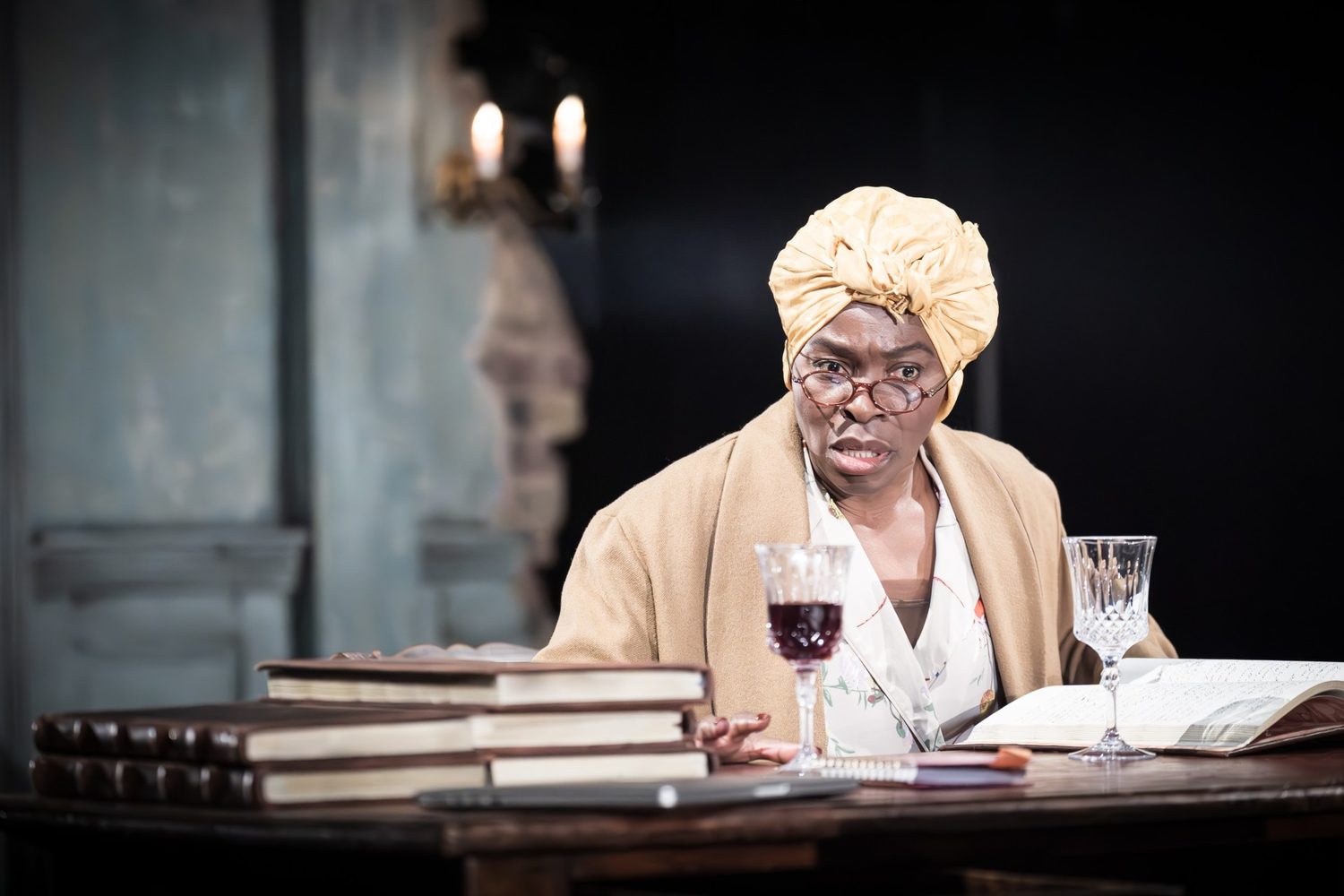
Rakie Ayola, a powerhouse of the British stage and screen, is barreling toward an ADR session in an Uber for a film she can’t quite talk about yet. It’s a chaotic (and amusing) backdrop for a conversation with Clementine Melvin about The Authenticator, the comic thriller she is currently starring in at The National, that follows two Black academics tasked with verifying the journals of an 18th-century enslaver. Ayola speaks of the playwright Winsome Pinnock’s specific brilliance with warmth, noting, “Every thought Winsome has ever had about the relationship between colonialism and enslavement is in there, but perhaps not from the point of view you’re used to hearing.”
For Ayola, tackling a play that deals with this history brings a certain baggage. She notes that at times, “it’s a bit like finding yourself laughing at a funeral.” It’s a delicate balance; she describes a rehearsal process that required a mental sign over the door, granting the cast permission to find the humor in the dark so they could confront the history without being consumed by it.
The Authenticator in on through May 9th.
 london

Clementine Melvin: I just want to say thank you. I saw the show on Wednesday night—
Rakie Ayola: It’s wild, isn’t it?
CM: I was so surprised. You read what the show’s about and it sounds like it is going to be an intense evening, so I wasn’t expecting to have such a fun evening. Everyone had such a fun evening.
RA: I think it’s really surprised people. I say it’s like a play written for the Royal Court but meant for the Bush Theatre. When the Bush audience follows us to the National, they love it. Even now, one of the hair and makeup women cannot believe the love that the kente scarf gets at the end. She’s almost offended because she doesn’t understand it. I think she’s Eastern European and she simply can’t understand why that moment is funny. I see the people laughing loudest are the Black audience members because they absolutely get it. She’s constantly asking, ‘Why is it funny?’ and I love the fact that she doesn’t know why.
CM: I don’t think I’ve ever sat in the Dorfman whilst it rocks with laughter. It should be rocking with laughter; it’s an absolute joy. Are you having fun doing it and playing this show?
RA: Absolutely. It’s a play for right now. It was really challenging to find the tone because we didn’t know exactly what it was; Winsome had thrown every idea she had on the subject into it. We knew it was humorous, and Miranda Cromwell [the director] would say, ‘It’s funny, it’s okay that it’s funny,’ but we would wonder, ‘Is it?’ I think when you do a play that deals with awful history, you bring a bunch of baggage that gets in the way. It’s a bit like finding yourself laughing at a funeral. You leave rehearsal wondering, ‘Was I allowed to enjoy that moment? Should it not be traumatic every second?’ It made it very challenging. We almost needed a sign above the rehearsal room door that said: We will take it as read that everybody here feels the same way about this history. Now, let’s do this play.
CM: For people who haven’t seen it, but we will make sure they know to go and see it, what is The Authenticator about?
RA: So, it’s about two academics, Marva and her senior Abby, are invited to go and view six journals that were written by Henry Harford who was an enslaver that were found in Harford Hall by his descendant Fen. The play involves Fen, Marva, and Abby at Harford Hall, learning what the journals are about, learning what the house is about and learning what each other are about. It’s a dark comedy. Well, it’s a historic dark comedy ghost story!
CM: It’s all those things. All those very English things. The murder mystery element, which is so quintessentially English, set in a stately home. Jon Bausor’s set is just incredible.
RA: It’s so great to be on. Sometimes you’re on a fantastic set that doesn’t help you as an actor at all. That happens a lot! It might look great for an audience, but once you’re actually on it, it’s a different story. But this one is lovely to be on. We have one primary set that becomes several different rooms in Harford Hall. With the fantastic lighting and the way the ceiling moves up and down; it’s almost like a board game of a set. It’s delightful the way things appear and disappear. So, expect to laugh; it is very funny. You will also learn something, and it’s incredibly thought-provoking. Every thought Winsome has ever had about the relationship between colonialism and enslavement is in there, but perhaps not from the point of view you’re used to hearing.
CM: In terms of surprises you’ve had from rehearsal to performance, is the laughter the main one, or has your relationship to the play constantly changing? Is it still evolving as you play it now?
RA: It’s changing because we’ve realized it’s okay to enjoy it. I remember telling Winsome, “My character is having a good time in this house,” which is part of the baggage an actor brings—you wonder if you’re even allowed to have fun in a place with this history. I had to create a woman who knows the history inside and out but still enjoys herself there, at Harford Hall. Rehearsal was about becoming okay with that. You think, “I’m not sure I like a woman who’d enjoy this house,” and then you realize you would, too. When my husband and I got married, we hired a ten-bedroom house on Blackheath. It was only later we discovered it was built by [Henry] Tate or [Abram] Lyle so they could watch their sugar ships coming up the Thames. It was a great house, but if we’d known the history beforehand, we might have said “we can’t,” but the truth is, in this country, you’d never step foot in anything built before 1960 if you applied that rule across the board.
CM: What you’re saying about the origin versus the current function of a building—and what that represents—is so interesting. In the play, while you’re in the house, you hear all this noise outside and Fen is confused, only to see that they’re filming a music video in the grounds of Harford Hall. It highlights how these stately homes and estates are now trying to survive financially and keep the roof on by pursuing these different strains of commerce, which is so ironic given the setting. It’s amazing how well that’s captured.
RA: Isn’t it great that Winsome has seen all that and managed to throw it all in with just a couple of lines? I love her shorthand. Within a few lines, we learn that this house is now an income stream: a film company has left costumes behind, and Abby likes horses, which is Winsome’s shorthand for showing an audience that she comes from money. As actors we were scratching our heads over what it all meant, but it really means exactly what you think it means. It’s deep, but no deeper than that, if that makes sense.
CM: It does. When I came back, one of my housemates asked what I’d seen. I explained the premise of the show and she said, “Ooh, that sounds like a lot.” I told her, “This is going to sound awful, but I had such a fun evening.” It’s a textured show. It addresses sticky and heavy topics with lightness and levity. Which doesn’t mean that those topics and issues aren’t being treated seriously; if anything, they permeate even more because you’ve had a good time while such issues are being raised; laughing whilst simultaneously questioning your own reactions and assumptions.
RA: Thanks. Yes, absolutely. I think Winsome really wants to say that we have to be able to live and we’re allowed to have a good time. It’s good to be educated, but we still need to allow ourselves to enjoy the finer things in life if we can.
CM: Which is wonderful, as it challenges the audience’s assumptions. You said that it feels like a play written for the Royal Court but with a Bush Theatre audience in attendance. Where do you go for exciting theatre? People always want recommendations. Are there places you suggest, or anything coming up that people should see?
RA: Well, it finishes this weekend, but I went to the matinee of The Cherry Orchard at the Donmar yesterday. If you can catch it before Saturday, it’s really great. I went with my husband, a friend, and my 21-year-old; we managed to hold it together during the show, but in the bar afterward, the four of us just burst into tears. My husband had tears in his eyes and that set the rest of us off. We were just in a circle holding each other. It’s so subtle—and I mean this in the best way—it’s as delicate as our play isn’t. Deian Zor has done a beautiful job directing it. Other than that, I always have a good time at the Bush. I like what Lynette [Linton] and Daniel [Evans] are trying to do. Even when I don’t love a specific play there, something is always being said about the way we live now. The audiences there are so honest. I did a play there last year where I would come on for the final scene and hear people go, “Oh, here she comes,” because of how they felt about my character. The assistant director asked if I was okay with that hostile energy, but I loved it. It meant they were so with the play. It was my job to see if I could get them to understand why she did what she did. I love stepping into an electric atmosphere like that. I also usually have a really good time at Southwark Playhouse. I’ve been to their theatre in Elephant & Castle and I love their taste.
CM: Thank you. Now, before I forget, I wanted to ask—there is a scene in which your character is very drunk. Can you talk about the challenge of acting drunk?
RA: Acting drunk is always a worry! Early in rehearsal, the script had us positioned on the floor. During a research trip to a house in Kent, we saw a cellar with meat hooks on the ceiling for hanging deer as part of the culling process; it was a weird, visceral image that stayed with us. When we got back to the rehearsal room, we realized that if the cellar in the play was truly that cold and damp, we wouldn’t actually be rolling around on the floor. After about four weeks, our director, Miranda Cromwell, said the “drunkenness” of the scene wasn’t working. We tried it sober, but Sylvestra who plays Fen, felt her character wouldn’t be singing those old songs unless she was wasted. I suggested we just stay off the floor and act more naturally, which made a massive difference—having chairs to lean on really helped. Ultimately, you just have to lean into the intensity and earnestness of every “drunk” thought you’re having. It’s always a worry, though. Were you convinced?
CM: Yes! It’s hard because audiences are so hyper-attuned to “drunk acting,” but it was glorious how that scene descended. It’s a wonderful play and a brilliant performance. I wish you the best of luck with the rest of the run.
RA: Thank you so much. It was really lovely to talk to you.
Share a commentWe’d love to hear your thoughts