
 My Melodrama

 Catch while you still can
“Oh—you’re still playing the clarinet?” Spotlight On Carnegie Hall’s Ensemble Connect
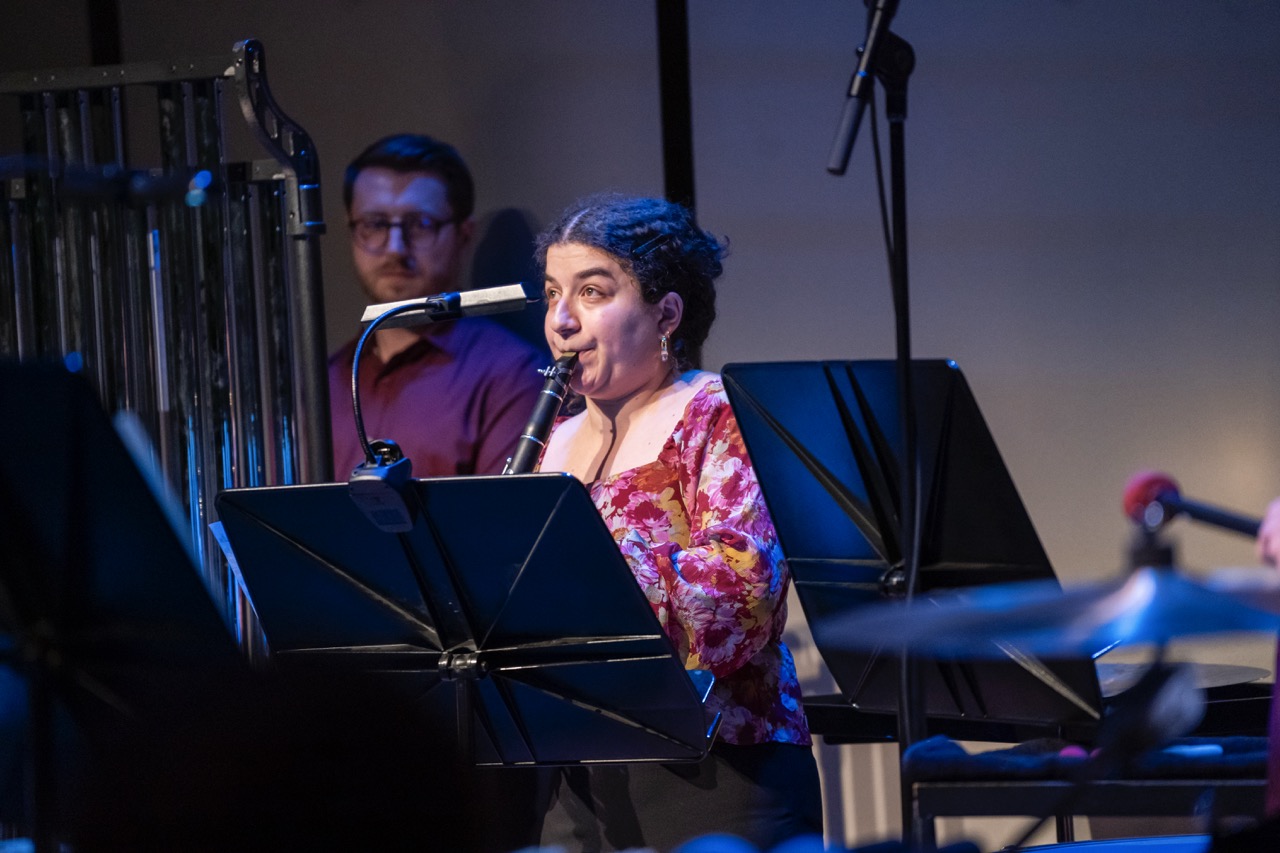
The young Armenian-American clarinetist Anoush Pogossian is at the start of her career, thinking carefully about who classical music is for. She is a fellow with Ensemble Connect which brings emerging classical musicians into Carnegie Hall and asks them to do more than perform: teach, connect, and find new ways to bring audiences into the room.
We spoke with Anoush ahead of a Carnegie concert about making music feel personal rather than abstract. “When it feels like something you want to share,” she says, “that’s when the bridge happens.”
 london

MELODRAMA: Talk to us about the clarinet. How did it become your chosen instrument?
Anoush Pogossian: Both my parents are professional musicians—they’re violinists—and my siblings play viola and cello. I started on the violin, but it never really stuck… Then in fourth grade, my public school had a music program where you could rent instruments for $50 a year. So my best friend and I chose the clarinet, mostly because we wanted to do it together.
M: Are your friends now all in classical music?
AP: None of them are. The question I get all the time is, “Oh—you’re still playing the clarinet?” I try to explain that it’s actually my job now, but being a musician is hard to describe. It’s a mix of performing, teaching, fellowships, orchestral work, chamber music—it’s a bit of everything.
M: So which bit gets you most excited?
AP: Chamber music, without question. I love playing in smaller groups. The concert series we’re doing at Carnegie is interesting because it sits in a grey area—it’s six players, but we’re working with the conductor Marin Alsop which has been incredibly inspiring, especially as she has a close relationship with the late composer of one of the pieces. The programme ranges from very gentle and sincere to chaotic and almost demonic. What’s fascinating is that sometimes the music is unbelievably dense, technically overwhelming—and then she’ll say, “The notes don’t matter. He just wanted the effect.” That’s both terrifying and freeing as a performer.
M: You’re part of a fellowship at Carnegie Hall—everyone knows Carnegie Hall of course. How do you pitch a performance to friends?
AP: A lot of young musicians are asking: what music do we wish existed, and how does it connect to our lives now? For this concert, the question is coming from Marin, and we’re answering it together. It’s American music, but not as celebration—it’s more personal, especially in the current political climate. What does it mean to present American music today, in New York? That tension is part of what makes it feel alive. So when we as performers invite the audience into a shared question or experience, rather than presenting something at a distance, that’s when the bridge happens. That’s something Carnegie really supports in this series.
M: These concerts are described as immersive—what does that actually mean?
AP: For this one, the space is small, the audience surrounds us on three sides, and we talk throughout the performance—about the music, the arc of the programme, what it means to us. It breaks down the boundary a bit!
M: Outside of rehearsing—are you constantly listening to classical music?
AP: Not anymore. As a kid, I listened almost exclusively to clarinet music, which is… embarrassing in hindsight. These days, classical music is maybe 20% of what I listen to for pleasure. The rest is jazz, folk, indie—my Spotify Wrapped is always a mess!
M: Is there a living composer more people should know about?
AP: Yes—Hannah Ishazaki. We met when we were 15, studied together at Juilliard, and she’s now doing incredible work. She has this amazing ability to take apart sound and reorganise its meaning, and she’s deeply collaborative. You always know what her music is trying to say. She’s actually writing a new piece for us next year that we’ll premiere during our residency and at Carnegie Hall.
M: Dream venue?
AP: For a long time, it was the Proms—and I actually got to play there with the National Youth Orchestra. Now, I’d say Vienna. I’ve never performed in Austria, and the musical history there feels almost tangible. Playing in one of those halls would be incredible…

Leave A ResponseWe’d love to hear your thoughts on this show!
You must be logged in to post a comment.