
 My Melodrama

 Catch while you still can
DESIGNER TERESA VERGHO’S NEON-HUED TROLLS AND MECHANICAL DOLLS
Whether she is transforming actors into neon-hued trolls or mechanical dolls, the Berlin-based costume designer Teresa Vergho views the human body as a site of radical construction. Having collaborated with many of the most avant-garde directors of today—from Susanne Kennedy to Ersan Mondtag—Vergho’s work is a study in Tim Burton-meets-Bauhaus surreal eccentricity.
Drawing from a lifelong fascination with everything from action figures and plastic monsters to the people she sees on the subway, her silhouettes bridge the gap between distortion and playful darkness. She speaks with MELODRAMA about the euphoria of working with costume workshops and her most grotesque, fantastical projects.
image sources
- Ein Sommernachtstraum,: Ein Sommernachtstraum, Photo By Eike Walkenhorst
 london

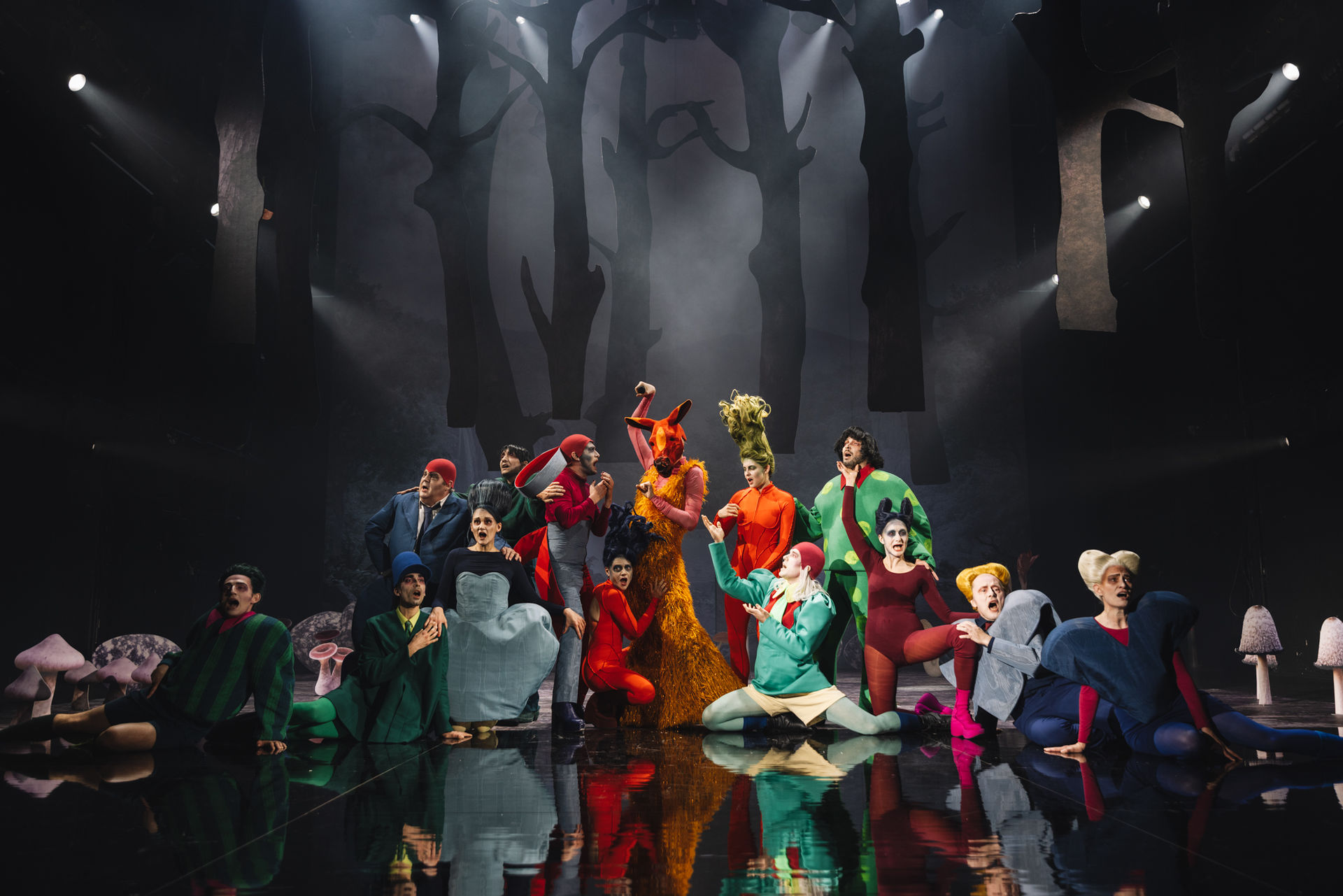
Louise Snouck Hurgronje: I’ve been following you and your work for a while, but when I saw your recent creations for Ein Sommernachtstraum (A Midsummer Night’s Dream) at the Schauspielhaus in Zürich pop up in my feed, I knew I needed to get in touch! These designs feel like a divine cross-over of Bauhaus meets Tim Burton, and I’m also getting notes of the Capitol (A Hunger Games reference for which I can only apologise). Are any of these references accurate?
Teresa Vergho: I love that description, it sums it up perfectly! It wasn’t exactly the intention, but since I studied in Dresden, close to the origins of the Bauhaus movement, I’m naturally familiar with that style. And of course, I love everything by Tim Burton. You wouldn’t automatically associate these two aesthetics, but that’s where it gets interesting.
LSH: Let’s go back to the beginning. How did you get into costume design? And how did you discover that this could even be a career?
TV: I fell in love with the theater as a teenager; the combination of literature, visual art, music, and live energy fascinated me. I’ve been interested in clothing since I was a kid—one of my favorite things to do was sew dresses for my Barbies. So it felt like a natural fit to go into costume design. After high school, I applied for an internship at the theater and never really left. I stayed for a tailoring apprenticeship, studied stage design, and eventually ended up as a costume designer.
LSH: Your work is so distinctive for its marriage of architectural silhouettes and a certain surreal eccentricity, often punctuated by incredible wigs. Is this an intentional signature of your vision, or are you drawn to projects that demand a more abstract visual language?
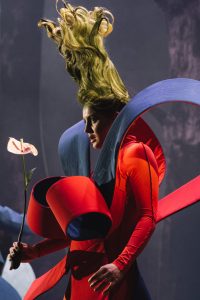
TV: For me, make-up and wigs are almost the best part of working as a costume designer! Creating costumes is fantastic, but the designs only really come to life when the wigs and make-up are added. It’s such a privilege to work with people who bring so much technical and artisanal skill and knowledge to the table, and who, through their artistic eye, make a design truly complete. I often try to create self-contained worlds that don’t stop at the clothing, but encompass the entire body: hair, skin, eyes, teeth, the whole shape. I love pushing the boundaries of what’s possible—maybe that’s where the architectural element comes in—but I try to stay connected with the human body in a playful way.
LSH: Is there a production that stands out in the wig and make-up department?
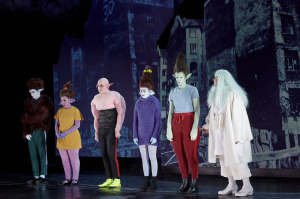
TV: For Hasstriptychon, we transformed the actors into evil little magic trolls with green or blue skin, shaggy mops of hair, pointed ears and bulging bodies. It was a challenge, but everyone enjoyed the transformation. Conversely, sometimes the world you want to portray is so fragile that you ask how little costume and make-up you need to convey a character. Sometimes all that’s left is the naked body.
LSH: Two of my favourite productions for which you created the costumes are Toto Oder Vielen Dank Für Das Leben and Le Grand Macabre. Both of these exemplify the style I just mentioned, can you talk a little bit about these projects?
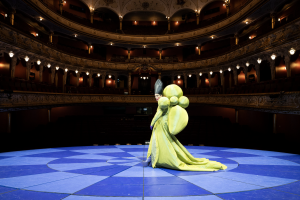
TV: Both of these productions were very unique. Toto depicts the life of a pure-hearted individual in the cruel world of postwar Germany, from the GDR to the near future. The challenge was to span six decades and two political systems with a vast array of grotesque, exaggerated, yet still relatable characters. It required an incredible number of costumes and enormous wigs. Le Grand Macabre is even more grotesque and fantastical. It’s a dystopian story about the end of the world, for which we found a colorful comic book style. The music is very garish in places and I had a blast finding a visual counterpart. We had a truly amazing ensemble that embraced the body transformations and eccentric shoes, filling them with voice and life.
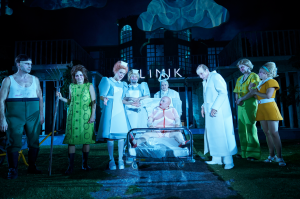
LSH: How does your creative process begin? Take the designs you made for the opera I Capuleti e i Montecchi at Opéra de Nancy in 2024 for example. At what point in the journey did you settle on a full western theme?
TV: The impetus came from set designer Michela Flueck, who saw it as a backdrop for the opera’s potent masculinity. In this opera, there are basically only men; all of whom are very similar, almost interchangeable. I researched images of historical cowboys and the stereotypes of that world, and found it most interesting to make them look like little toy figures. They are part of Giulietta’s (the only woman at the center of this story) universe—the toys she surrounds herself with. Her love is so self-centered that it hardly matters whether she’s playing with the red Romeo figure or the blue Tybalt figure. It has a lot to do with the right materials, colors, and shapes. Plastic-like fabrics, angular, masculine silhouettes contrasted with soft, rose-adorned female bodies reveal a great deal about the characters’ emotional worlds.

LSH: Your sketches are often stand alone works of art. Almost Botero-esque!? How did you develop this style?
TV: At some point, I realized I really enjoy drawing the characters I have in my head. When I started, figure drawings were kind of frowned upon—people mostly used collages or mood boards. But it really helps me to have the designs pass from my head through my hands. It helps me get a feel for the details; shapes, silhouettes and bodies and to convey the atmosphere or world I want to create to the workshops and performers.
LSH: I’d love to talk about your collaboration with director Susanne Kennedy in 2019 on Drei Schwestern for the Müncher Kammerspiele. What did the process in creating these mechanical dolls look like? How was it working together with someone like Susanne who so radically interrogates what the theatre can and should be?
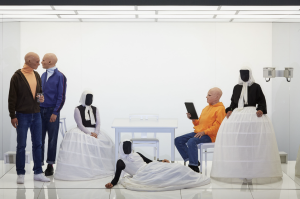
TV: Susanne is someone who radically explores and challenges boundaries. That’s what fascinated me so much about working with her: she knows exactly what she wants, but she allows for a process in which everyone is involved. Many of the decisions that she makes seem to be very intuitive, but they are made with a massive foundation of research. For Drei Schwestern, we used references to carnival traditions and modern outfits, and, of course, the masks. During rehearsals, we had a repertoire of costumes and masks that we experimented with until we reached the moment when it was clear: this is it.
LSH: How does living in Berlin inspire you? Where else do you seek inspiration?
TV: I’m actually almost always on the go and gather my inspiration along the way, so to speak. Right now, I’m in Vienna—the city’s morbid glamour and dark humor definitely influence my work here. I find bodies more interesting than clothes; I find inspiration in people on the subway, on the street, different concepts of the body in art and literature, in superhero comics, and in nature. As a child of the ’80s, toys are often a huge inspiration for me: I love action figures and plastic monsters of all kinds!
LSH: What do you find to be the most exciting part of a production?
TV: I love the whole process of working with the workshops—from sampling fabrics and discussing the cuts, to the final fittings. I just love how skillful and thoughtful the cutters, tailors, and make-up artists are. My work on Sommernachtstraum at Schauspielhaus Zürich is a perfect example. Because the workshops there are smaller than at a major opera house, the team was initially reluctant when they saw the sheer complexity of my designs. But as they began working, piece by piece, everything came together through the sheer dedication and expertise of every single person involved. At a certain point, I felt almost euphoric every time I walked into the workshop. What a privilege! I also love the moment a design clicks with a performer and they start to resonate, carrying my ideas even further.
LSH: And lastly, any dream projects…?
TV: So many! I feel like designing a stage set again, or creating an installation where the boundaries of the body can be explored further. I could also imagine doing costume design for film, or developing my own line of action figures.
Share a commentWe’d love to hear your thoughts