
 My Melodrama

 Catch while you still can
THE AUDIENCE SEES EVERYTHING: STAGE DESIGNER ETIENNE PLUSS ON VISUAL STORYTELLING
Stage design is often a hidden art. While audiences marvel at the final grand result of an opera, few realize the months of drafting, sculpting, and building work that happen before opening night. Etienne Pluss is one of the opera world’s most sought-after stage designers and a master of using physical spaces to tell deep, emotional stories.
MELODRAMA caught up with Pluss to go behind the scenes of his latest project, Of One Blood at the Bavarian State Opera in Munich. He tells us about his several trips to Westminster Abbey to examine Elizabeth I and Mary Stuart’s graves (the two women, who never met, are buried 10 metres apart!) and the six months needed for four sculptors to recreate these tombs for the production.
image sources
- : M. Rittershaus
 london

MELODRAMA: You most recently designed the set for the new opera Of One Blood which is a reimagining of the fiercely rivalled cousins Elizabeth I and Mary Stuart. I read that you took several trips to Westminster Abbey (where the two women, who never met, are buried 10 metres apart!) in order to examine their graves. Graves which your workshop then proceeded to painstakingly and accurately re-make. Incroyable! Why did you decide that the graves had to be included in this story?
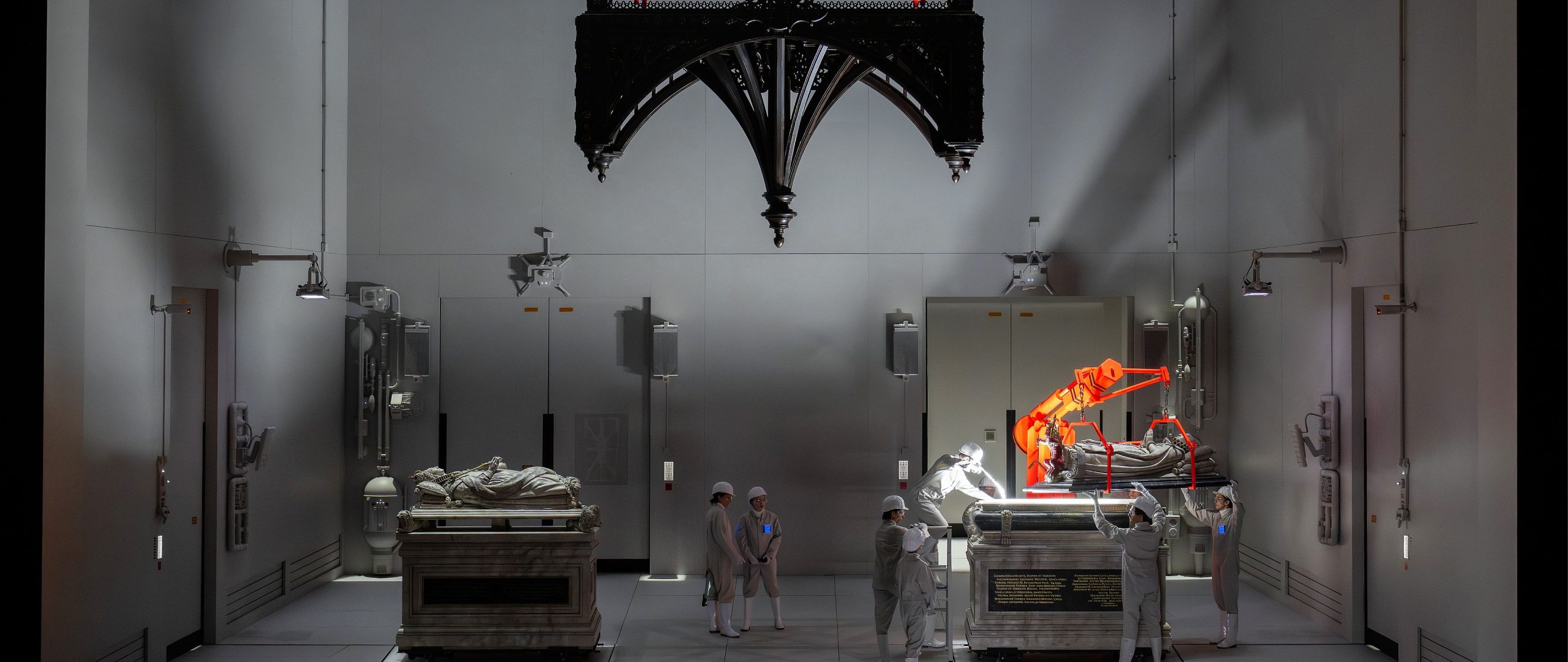
Etienne Pluss: By opening Of One Blood with an examination of the tombs of Elizabeth I and Mary Stuart, the decision to tell this story from a contemporary perspective is clearly established from the very outset. For this reason, I wanted to have these tombs recreated as accurately as possible; consequently, I indeed traveled to Westminster Abbey in London several times to meticulously document and photograph the two monuments. Fortunately, I was simultaneously engaged in preparations for another production at the Royal Opera House, which allowed me to conveniently combine these trips!
M: Can you tell us a bit about the process of building them?
EP: Yes, the tombs themselves were far too large to be recreated on stage at a 1:1 scale—particularly given their towering columns and canopies—because I ultimately had relatively limited space to work with on stage. I therefore had to capture the essence of the pedestal designs and adapt their proportions through drafting, all without compromising the immediate recognizability of these famous monuments. Construction began in the excellent workshops of the Bavarian State Opera: the pedestals were built in the carpentry shop, the sculptures and ornamentation were crafted by the sculptors, and finally, the painters executed the surface finishes—primarily to simulate marble. The sculptors likely spent the longest time on the project, working on the figures and the sheer abundance of intricate details and ornamentation. Four sculptors labored on the pieces for six months.
M: Unbelievable! Complete works of art. And what material was used to simulate the marble!?
EP: A wide variety of techniques were employed, though the figures themselves were primarily carved from a fine, high-density foam and subsequently finished with a fine surface coating.
M: So the decision was made to set the opera in a contemporary laboratory, where these graves are opened at the start of the opera. The contrast of the modern equipment against the dark wood of the throne and the 16th century graves is so cool. Is this something you enjoy experimenting with? The old against the new?
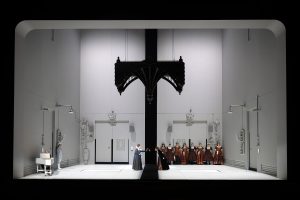
EP: Oh yes, absolutely. This contrast affords me the opportunity to tell a story more visually, rather than merely presenting historical facts. One aspect I found particularly intriguing was how the sterile, ultra-modern laboratory aesthetic serves to express the contemporary compulsion to understand and explain absolutely everything. At the same time, Heather Betts’s libretto was constructed exclusively from the original text of the letters exchanged between the two cousins. It is a fascinating body of material, one that continues to carry mystery with it. Ultimately, we may never be able to fully comprehend it; yet it will always serve as a mirror reflecting various facets of our present-day society.
M: I can recognise your distinct designs for their disciplined use of negative space and the cinematic texture of the backdrops which draws one into the set. Your stages are never crowded, and yet, they are so effective. Is this something you developed early on in your career?
EP: Since I have been fortunate enough to work as a stage designer for quite some time, I have had ample opportunity to experiment in the past. For me, the central question is: why are we telling a specific, pre-existing story, and how can we ensure it holds contemporary relevance? The visual outcome is “merely” the product of the long quest to answer this very question. And during this quest, one typically uncovers a wealth of fascinating themes, inspirations, and theatrical possibilities for creating a “narrative topography.” Only at the very end do form and aesthetics emerge—usually quite naturally—guided by this conceptual process, which, ideally, unfolds in close collaboration with the dramaturge and director.
I place little stock in the notion of a stage designer possessing a distinct formal or aesthetic “signature style.” If such a style exists, it is likely a matter of coincidence—or perhaps even an inability to constantly reinvent oneself. The story itself must always take center stage.
M: Speaking of stories. Where you seek your inspiration for each new story you build a universe for?
EP: It is always a lengthy process—one that begins with conversations with the team, followed by reading books, researching images, watching films, and traveling, always observing everything, people and landscapes, houses and situations. And then, more conversations. Eventually, my head is full—and only then do I begin making the first sketches. The apprehension surrounding those initial sketches is always immense—a source of internal stress—because they represent the very first step toward concretization. For me, the truly good ideas usually emerge while I am half-asleep, dreaming, or even out jogging…
M: Once you have finalised these sketches, you pass them on to the theatre workshop you are working with, what does this collaboration look like?
EP: One of the most beautiful aspects of my profession is having the privilege of working alongside so many different artisans in the workshops of theaters and opera houses around the world. In fact, very few audiences realize just how many people are sometimes involved in constructing a stage set—often laboring over it for weeks, if not months on end. The size of a workshop naturally depends on the scale of the opera house itself, as well as the volume of its productions. Staff numbers can range anywhere from 30 to over 1,000—as is the case, for instance, at the Bolshoi in Moscow. What is particularly fascinating, however, is observing that from one country to another, one consistently encounters similar personalities within the various workshop departments—and, very often, wonderful artists who share that same deep fascination with the stage.
M: And do you ever enjoy physically working on any part yourself?
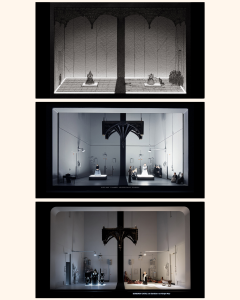
EP: I would love to be more involved in the actual construction process, but it’s unrealistic as I am constantly required to be in different locations. My contribution to the creation of the stage design, however, lies in building the model—usually at a scale of 1:33. It is very important to me to build it myself, as this allows me to do a great deal of spatial invention and discovery. Furthermore, a high-quality and precise model serves as a highly inspiring—and indeed essential—foundation for the workshops; it also demonstrates respect for their work.
M: You studied under the visionary German opera director Achim Freyer (who, in turn, was Bertolt Brecht’s protégé), what was the greatest lesson you learnt under his mentorship?
EP: He taught me both the fundamental laws of visual stagecraft and a profound faith in the significance of the theatrical moment. And in this context, every single detail carries meaning… The audience sees everything. Achim Freyer is a truly great and legendary artist—a director, a stage designer, and, above all, a painter. During my studies, working with him wasn’t always easy, as he found my drawings too complete—too perfect. Somehow boring, stiff, and lifeless. It took a long time before I was able to let go and sketch more freely, to learn to trust the movement of my hand more than the tip of my pencil.
M: Do you now have firm collaborators that you most enjoy working with?
EP: Over time, I have had the pleasure of working with excellent colleagues—assistants, directors, costume designers, and, of course, lighting designers. There is a close circle of colleagues with whom I particularly enjoy working; yet, at the same time, I consider it important to remain open to new encounters. For me, flexibility—and the willingness to engage in new collaborative ventures—is fundamental to working in the theater.
M: Now, on to a few specific productions… It’s so interesting that even when you choose a dark palette (for example in Don Carlo at Teatro San Carlo in 2022), the effect is intriguing and mesmerising rather than boring (which can sometimes be the case). Do you like leaning into the darkness?
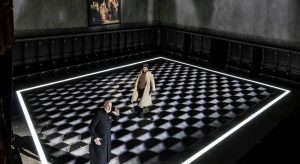
EP: I cannot really explain it. It likely stems from the narrative itself. As a person, Don Carlo was evidently deeply unwanted; he had no place within the rigid framework of his world—absolutism, strict Catholic dogma, and the Spanish Inquisition—nor within his own family. It was a desperate struggle, only to vanish ultimately into a black “nothingness.” Given this, it seemed only natural to employ strong contrasts—profound darkness—and to create no true place for him on the stage. He was constantly exposed, observed, controlled, and destroyed at the end.
M: Your boarding school set for Scylla and Glaucus at the Opernhaus Zürich can be attributed to a realm of magical realism I believe, would you agree? Audiences couldn’t work out where the school was situated, and yet, the attention to detail was unparalleled.
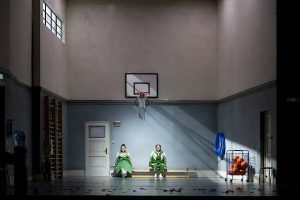
EP: It is always a joy to have the opportunity to work in Zurich, because they build with incredible precision and accuracy. This makes it possible to have the time and capacity to meticulously craft every detail. And yes, it would be fair to describe this stage design as magical realism. My aim was to find a setting that could provide a concrete framework for the Greek mythological narrative—a place where the human being is still in a process of formation: searching for themselves, doubting, and capable of change. The hierarchy of the gods finds a fitting home in the school teachers.
M: Completely agree! You mention Zurich, is there another theatre that holds a special place in your heart? One which has wielded the most brilliant creative result perhaps?
EP: There are places where I genuinely love working time and again—Aix-en-Provence, for instance—but there are also so many others where I was fortunate enough to share incredibly intense theatrical experiences with wonderful people. The list would be very long. However, in answering this question, I realize just how truly passionate and magnificent this profession is. The downside is that it involves far too much work, and that you are rarely at home.
Share a commentWe’d love to hear your thoughts